DEIS Files available

The FERC site has been down since Friday night, and people are freaking out (and rightfully so!) that this is eating into the 45 day comment period.  I was lucky that I got one of the FERC CD-ROMs with the DEIS files. Those files have been uploaded to our sister site http://pipeinfo.org on the front page.

If you have any issues downloading any of the files or think anything is missing, please let me know!

http://pipeinfo.org


DEIS: FERC’s Admissions that the DEIS stinks

Below is the FERC staff’s comments about the DEIS not cutting it.  These are areas where FERC wants an answer back from PennEast before the DEIS comment period is finished.

To me – here FERC is admitting that the DEIS is incomplete, and they are violating the public’s ability to comment within the comment period on these developments.  PennEast could in fact offer answers to these questions on day 45 – giving the public ZERO DAYS to comment.

FERC Recommendations

These come from FERC’s section on “Conclusions and Recommendations”, and is in the area where they are also recommending conditions on the final order.  These though are specifically the “within the DEIS comment period” asks.

Point 15: Prior to the end of the draft EIS comment period, PennEast shall file with the Secretary the results of its ongoing evaluation of potential presence of working and abandoned mines near the proposed crossing of the Susquehanna River. The evaluation shall include documentation of coordination with the Pennsylvania Bureau of Abandoned Mine Reclamation, and shall identify any specific design or mitigation measures. (Section 4.1.5.4)

Point 19: Prior to the end of the draft EIS comment period, PennEast shall file with the Secretary documentation to identify any special construction procedures that will be implemented to minimize impacts on C-1 streams. PennEast shall provide documentation of consultation with appropriate federal and state agencies regarding C-1 streams, including identification of any agency recommendations and PennEast’s responses. (Section 4.3.2.2)

Point 20: Prior to the end of the draft EIS comment period, PennEast shall file with the Secretary proposed crossing methods for all waterbodies, including those with contaminated sediments. The proposed method shall ensure that the potential suspension of sediments during construction shall be avoided or minimized to the greatest extent possible so as not to change bioavailability of any potential contaminants present. PennEast shall include documentation of consultation with pertinent agencies and identify any recommended minimization measures. (Section 4.3.2.2)

Point 26: Prior to the end of the draft EIS comment period, PennEast shall file with the Secretary the special construction methods that it will implement during construction in extremely saturated wetlands. If additional workspace is required at the saturated wetlands along the pipeline alignment, PennEast shall identify these in a table and provide site-specific justification for the additional workspace. (Section 4.4.2)

Point 32: Prior to the end of the draft EIS comment period, PennEast shall file with the Secretary the measures or changes that it will implement to the Project’s design in order to ensure that the Project is consistent with the FWS requirement to avoid all bat hibernacula by at least 0.25 mile. PennEast shall also provide documentation of the consultation with the FWS on this restriction. (Section 4.6.1.1)

Point 42: Prior to the end of the draft EIS comment period, PennEast shall file with the Secretary any route adjustments, workspace modifications, or mitigation measures developed through PennEast’s ongoing consultations with landowners regarding the following planned and/or pending projects:

  1. a)  Fields at Trio Farms Subdivision;
  2. b)  Huntington Knolls, LLC Housing Development; and
  3. c)  Hopewell Township Emergency Services Facility.

PennEast shall provide documentation of correspondence with these landowners. PennEast shall either incorporate these deviations or a route that avoids the resources of concern, or otherwise explain how potential impacts on resources have been effectively avoided, minimized, or mitigated. (Section 4.7.3.2)

Point 43: Prior to the end of the draft EIS comment period, PennEast shall file with the Secretary an update of the status of the development of the site-specific crossing plans for each of the recreation and special interest areas listed as crossed by the Project or otherwise affected in appendix G-14. The site-specific crossing plans shall include, as applicable:

  1. a)  site-specific timing restrictions;
  2. b)  proposed closure details and notifications (e.g., reroutes, signage, public notices);
  3. c)  specific safety measures; and/or
  4. d)  other mitigation to be implemented to minimize effects on the recreation areas and their users during construction and operation of the Project. (Section 4.7.5)

Point 45: Prior to the end of the draft EIS comment period, PennEast shall file with the Secretary documentation of USDA approval for construction and operation of the Project within any and all parcels affected that have active USDA conservation easements. Alternatively, PennEast shall identify any Project changes made to avoid parcels with USDA conservation easements, and include documentation of consultation with the USDA that confirms avoidance of USDA conservation easements. (Section 4.7.5.4)

Point 53: Prior to the end of the draft EIS comment period, PennEast shall file with the Secretary proposed mitigation measures to minimize noise levels associated with emergency or maintenance MLV blowdown events. Mitigation measures may include but not be limited to use of a silencer, restricting maintenance blowdowns to daytime hours only, and/or notifying landowners in the immediate area of the planned blowdown event. (Section 4.10.2.3)

Point 54: Prior to the end of the draft EIS comment period, PennEast shall file with the Secretary a complete noise analysis of the Project metering (interconnect) stations using the best available typical design or vendor specification with regards to impacts on the closest identified residences/NSA as shown in table 4.10.2-10. (Section 4.10.2.3)


The PennEast DEIS is out

The Draft Environmental Impact Statement is out.  It officially hit today from FERC.  Some quick facts:

  • We have until September 5, 2016 to comment.  That’s our deadline (45 days), in the height of vacation season.
  • You don’t have to be an intervenor to comment.  ANYONE can comment – and we want EVERYONE to comment.
  • Intervenors do carry more weight, and their protests must be answered in the final FERC order.
  • You can still Intervene!  We’ll have instructions up shortly to intervene-out-0f-time.

The full DEIS is available here:

http://www.ferc.gov/industries/gas/enviro/eis/2016/07-22-16-eis.asp

The plan is to get 50,000 (!) or more comments out there.  So start alerting your friends, your neighbors, your distant acquaintances, everyone you can.  Alert any intervenors you know, or people who should intervene.  CAPS, New Jersey Conservation Foundation, The Delaware Riverkeeper Network, Sierra Club, and others are all banding together to ensure there are sufficient in-person workshops, webinars, and anything else we can think of to get the issues with this DEIS thoroughly and completely documented.  We have 45 days, and we need to make the most of it.

Because this DEIS is a travesty.  In section after section FERC and their contractors state that they have insufficient information upon which to make a decision, and then they conclude each section that they have determined there is no significant impact to the environment.

We have no data on wells or springs in NJ or PA, and hope we’ll get some eventually.  But we’ve determined there’s no significant impact to wells or springs.

We have insufficient data on vernal pools, we’ll check that later.  But we’re confident there’s no real impact to them, and we’ll mitigate it somehow.

We have no idea about historical artifacts, properties, or areas within the impact area.  But we’re confident we’ll mitigate anything we find eventually.  Some day (as an aside: how do you mitigate impacts to unique historical areas?).

Their No Action Alternative is four paragraphs long.  Yes, four paragraphs.  They cite no sources or data, other than the list of shippers.  They point to that list of shippers and say “These shippers signed contracts. There fore, there can be no No Action Alternative”.  There is no mention of 7o% of landowners in NJ denying access.  No mention of affiliate transactions between companies like NJ Natural Gas buying the gas from New Jersey Resources, or PSEG Power buying from PSEG, etc.  They write off renewables and other areas without a single citation or data point.

And there’s no mention of storage, dual-fuel, or other alternatives.

This is a target-rich environment folks.  Let’s have at it.  More to come once we digest it in detail.

The slippery slope just turned into a slippery cliff

Last night I had the pleasure to be on PANJ Radio live with Jeff Titel of NJ Sierra Club.  The topic was, of course, the PennEast pipeline.  We did the show to help educate Lambertville residents on what’s going on with the pipeline, and get them pumped up about increasing Lambertville City’s opposition to PennEast.  I’ll post a recording of the session once it’s available.

In an attempt to add balance to the discussion, PANJ Program Director Rob Bell contacted PennEast and invited them to join the show.  As usual, PennEast declined the invite .  Not surprising, really, since as we all know PennEast has avoided all meetings with the public since the debacles at the Landowner-invite events in early 2015.  PennEast clearly does not want to be in a position to have someone actually question their claims live and in person.

PennEast spokes person Patricia Kornick did send a statement in though.  Most of it was the same old tripe, that can be summed up here.

1) Usage of home heat and electricity consumption is increasing, so we need PennEast

False: all projections, including those by eia.gov, show NJ energy demand to be flat out to 2040.

2) 90% of the capacity on PennEast is sold, so there must be a need for it!  

This is one of PennEast’s more dangerous arguments, where they are claiming there is a market need for this project because they’ve sold most of the capacity.

But what they don’t like to admit is this:

  • PennEast is a shell company owned by South Jersey Industries, New Jersey Resources, PSEG, UGI, Elizabethtown Gas’ parent company, and Spectra Energy.  And the “customers” on the pipeline are: South Jersey Industries, New Jersey Resources, PSEG, UGI, Elizabethtown Gas, and Spectra Energy.  Yes, this is classic “self-dealing”, not a real market.
  • The PennEast “customers” can only afford to buy natural gas by stopping buying gas from other pipelines.  Yeah, that’s right – with no increasing demand and all the existing pipelines in place, they can only accommodate PennEast by halting their existing contracts.  There’s no “need” here, only transferring money from other companies to themselves.

This graphic might help:

PennEastOwners

There you go – the PennEast owners – SJI, NJR, PSEG, UGI, AGL/Southern Company, and Spectra Energy.  And the PennEast “customers” – South Jersey Gas, New Jersey Natural Gas, PSEG Power, UGI Energy Services, Elizabethtown Gas (owned by AGL), Texas Eastern pipeline (owned by Spectra).

3) PennEast will reduce energy costs!

False.  Last year Kornick was making these assertions, and a journalist asked her to provide her with the cost projections PennEast had made to back up that claim.  Kornick sheepishly replied that no such projections exist.  This is a baseless assertion with no data or analysis to back it up.

4) PennEast will increase reliability

When numerous parties began shooting holes in PennEast’s “increasing demand” and “lower prices” story, they changed direction and said that it was really all about “reliability” and “reducing constraints in the system”.  They pointed to the bogus Concentric study they commissioned showing a mythical $890 million the region would have saved if PennEast went back in time and existed during the polar vortex winter of 2014.

Here’s the reality: there are no such constraints in NJ.  As a state we are awash in Natural Gas and simply don’t need any more.  And you don’t have to  just take my word for it.  PennEast’s own owners same the same thing as well.

Every year, SJI’s annual report and SEC 10K filing gives a detailed breakdown of their gas supplies and system reliability.  In 2015 their peak load was just over 500 million cubic feet in a single day.  But their contracted supply allows for 630 million cubic feet.  So they had a 130 million cubic foot margin on their worst day.

They have multiple suppliers and options, including multiple pipeline suppliers and alternate storage solutions, including their own LNG storage and vaporization facilities.

Their 10K indicates that they have more than adequate supply and diversification in their system.

The same story is repeated in prior years, including the polar vortex winter.

NJR tells a similar story in their 10K filing, concluding:

In fiscal 2015, NJNG purchased natural gas from approximately 86 suppliers under contracts ranging from one day to one year and purchased over 10 percent of its natural gas from two suppliers. NJNG believes the loss of these suppliers would not have a material adverse impact on its results of operations, financial position or cash flows as an adequate number of alternative suppliers exist. NJNG believes that its supply strategy should adequately meet its expected firm load over the next several years.

This story is repeated over and over again in the other partner’s filings as well.  There is no reliability issue for natural gas in NJ.


5) PennEast is the first pipeline to pipe Marcellus gas into NJ

I saved the best for last.  This whopper is a new one that Kornick is trying out for the first time.  And it’s a doozy.  Here’s what she says in its entirety:

The PennEast Pipeline will be the first system to bring natural gas directly into New Jersey from a local, abundant natural gas supply.

It is mind boggling that PennEast would even go here.  In fact there are many pipelines coming out of the Marcellus region into our area.  EIA.GOV has the details:

http://www.eia.gov/todayinenergy/detail.cfm?id=24732

Part-PennEast owner PSE&G also disagrees with Kornick on this – right within PennEast’s own application to FERC!  In it, they state….

“PSEG, as the largest utility in New Jersey and one of the largest buyers of Marcellus Shale supplies in the northeast…”

In their SEC filings, PSEG goes on to indicate that they already get the majority of their natural gas today from the Marcellus region – all without PennEast not being in existence.

Conclusion

So PennEast is continuing their campaign of disseminating misinformation throughout the region.  No surprise there.  But what is surprising to me is that they continue to stretch the truth a little more each time.

For those interested, here’s Kornick’s statement in full:


Hello, Mr. Bell.  I appreciate your contacting the PennEast Pipeline
Project.  I am the project spokesperson for PennEast.

I am providing some key information to supplement information from the

web site.  The information should help in moderating an informative,
balanced segment:

* In addition to millions of local families and businesses relying on

the electricity produced by natural gas, approximately 75 percent of New
Jersey homes and more than 50 percent of Pennsylvania homes rely on
natural gas for heat.  Whether for home heat, or the electricity that
powers the lights, air conditioners, televisions and computers and charges
phones, that use is increasing.

* PennEast’s capacity is under long-term contracts from local public

utilities and electric generation companies that recognize the need for a
local, abundant and affordable energy source.  With approximately 90
percent of the pipeline fully committed, the local market demand for the
PennEast Pipeline Project is clear.


* Rather than relying on natural gas being transported from

Pennsylvania, down to the Gulf Coast and then returning to serve area
energy consumers, the PennEast Pipeline will be the first system to bring
natural gas directly into New Jersey from a local, abundant natural gas
supply.

* As such, the PennEast Pipeline Project will reduce energy costs to

area natural gas and electricity consumers.  It also will increase
reliability by alleviating constraints on the existing pipeline system,
which are most evident during storms and extreme weather conditions.

Based on input from landowners, public officials and others, PennEast
has reviewed more than 100 route options.  Where safely and logistically
feasible, PennEast has implemented dozens of modifications as a result of
such feedback. *


As evidenced by the approximately 2.6 million miles of pipelines across

the United States, including in New Jersey, transmission pipelines exist
harmoniously across rural and urban communities alike. Following pipeline
construction, the property is restored. Landowners may continue to use
their property as they had prior to construction, with the exception of
building directly atop the pipeline or planting trees. Recreational and
farming http://penneastpipeline.com/working-with-agriculture/ activities
also may continue. (PennEast is continuing to work with landowners to
ensure their property-specific preferences are reflected in their easement
agreements.) *


PennEast recognizes that not everyone understands or appreciates the

environmental, economic or practical aspects of building natural gas energy
infrastructure, such as the PennEast Pipeline Project.  Yet, clean-burning
natural gas literally fuels the quality of life for most Americans —
including those using their mobile phones and computers to oppose natural
gas development. *


While there are vocal pockets of people opposed to natural gas

development, the majority of area families and businesses welcome the
reduced utility bills, increased reliability and the other practical,
environmental and economic benefits that PennEast Pipeline will bring to
the region.

In fact, the majority of business and trade organizations within the

region have rendered support for the Project:
http://penneastpipeline.com/supporters. [2].


Additionally, those opposed to natural gas development, and this Project

in particular, are going to great lengths to try to stop the Project,
including filing lawsuits:
http://penneastpipeline.com/new-jersey-superior-court-sides-penneast-dism
isses-baseless-trespassing-lawsuit/ or commissioning “studies” (
http://penneastpipeline.com/wp-content/uploads/2015/03/Concentric-respons
e-to-NJCF.pdf) and espousing the findings as fact.

 

PennEast Timelines

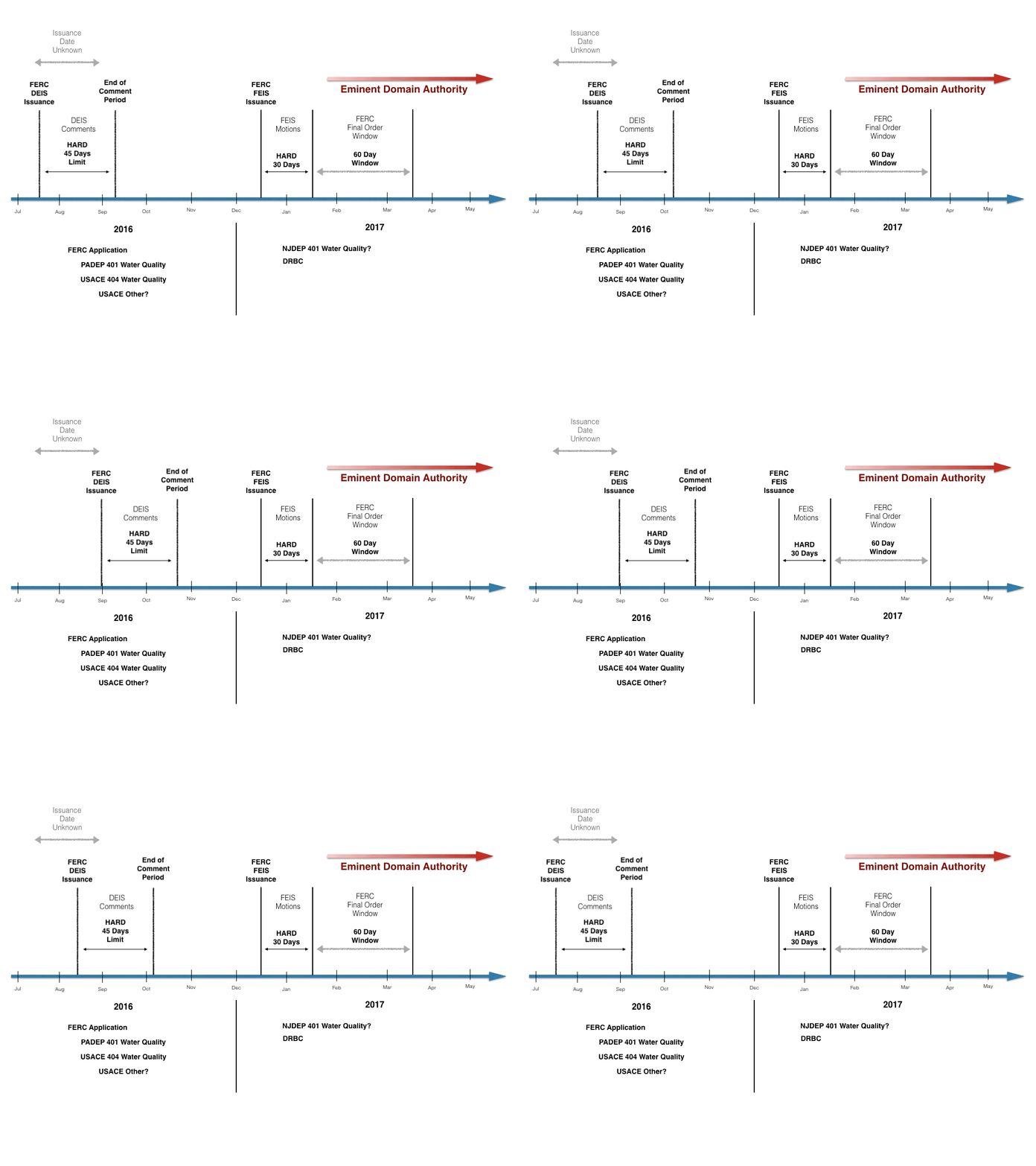
It’s hard to believe 2016 is more than halfway gone.  And along the way we’re starting to come up on some critical deadlines on PennEast.  The kicker is – we don’t know exactly when those deadlines start!  But some of them have extraordinarily short windows in which people can act.

So to help give people a sense of what we’re dealing with, I’ve put together a visual aid to demonstrate what the timelines look like.  Below is an animated .gif file showing the major FERC milestones coming up for PennEast.

PennEastTimelineAnim
FERC Timelines

As you can see, we don’t know exactly when the DEIS will be issued, but we do know there will be a 45 day comment window.  This window is critical as it forms the basis of any action you want to take against the project in federal court.  That 45 day period forms the only legal record that matters.

So you can see the DEIS could drop today – or we might still have a month or more.  It’s hard to say.  This slides the end of the comment period any where from the beginning of September to near the end of October.

We know the rough size of the DEIS issuance window because FERC has said they will issue the Final EIS (FEIS) in mid-December 2016.  And they will need some time to incorporate the DEIS comments into the FEIS.

However, if the DEIS comment window were to blow up with 10,000 comments – well, we’ll have to see what that does to FERC timelines.

After the FERC FEIS issuance, there’s a 30 day clock that starts when people can make motions against it.  Which I suspect they will.

After that, there is a 60 day window in which FERC can choose to release its final order in the matter.  That order will be: Reject, or Grant.

If that order is given as Grant, then PennEast will have federal eminent domain authority.  At that point in time PennEast will likely go for an injunction to get survey access on all properties that have denied access up to that point in time.

Below that we show some of the other permits involved.  We know some of them have already been applied for in 2016, such as PADEP and US Army Corp of Engineers (USACE).  Others have not yet been begun, and might not be until next year, including the NJDEP permits and DRBC permit (to clarify: the DRBC permit has been entered, but I’ve heard will not be actioned until 2017).

So it’s hurry up and wait time people.  But be prepared!  Once the DEIS hits we have a very limited time to get our comments in, and we want everyone to hit this one out of the park.