A losing proposition even for the pipeline companies-

Susan from Milford, NJ has made a series of FERC submissions which are very well thought out and make persuasive arguments against the pipeline. She continued with one today that is particularly on-point and should make the FERC sit up and take notice:

I call on the FERC to return the “NO BUILD” option for the PennEast pipeline project (hereinafter “PE”). Not only does this project offer NO benefit to the people along its route (it will take the gas to South
Jersey and New England, not to the residents along the proposed route in PA or NJ) but also it is becoming increasingly obvious that this project is not financially viable.

The six member companies of PE are listed as its “customers” but their distribution networks were already in place so there is no real customer increase. Despite PE’s vague denials, the only way PE could make back their investment would have been to get gas to New England, ready for anticipated LNG export stations, or to Cove Point for export. But according to the following article, (www.moodys.com/research/MoodysLiquefied-natural-gas-projects-nixed-amid-lower-oil-prices–PR_322439?WT.mc_id=AM~RmluYW56ZW4ubmV0X1JTQl9SYXRpbmdzX05ld3NfTm9fVHJhbnNsYXRpb25z~20150407_PR_322439) “Moody’s says low LNG prices will result in the cancellation of the vast majority of the nearly 30 liquefaction projects currently proposed in the US, 18 in western Canada, and four in eastern Canada.”

Without these anticipated export facilities, PE simply will not have the revenue from selling this gas to the existing customers of its 6 member companies. There are no new significant customer bases in NJ, nor any major coal-fired power plants to be upgraded along this proposed route.

Indeed, the Gilbert station in Holland Twp is already served by Elizabethtown Gas, and will only be a back-up station.

The article goes on to say “However, projects already under construction will continue as planned, which will lead to excess liquefaction capacity over the rest of this decade. Notably, through 2017, Australia will see
new capacity come online from roughly $180 billion in investments, which will result in a 25% increase in global liquefaction capacity. Likewise, the US is poised to become a net LNG exporter after the Sabine Pass
Liquefaction LLC (Ba3 stable) project goes into service in the fourth quarter of 2015.”

Susan is absolutely right. The Marcellus gas projects have always been somewhat tenuous because fracking is a very expensive operation compared to conventional gas drilling. You need fairly high prices to support it, somewhere in the neighborhood of $4 per thousand cubic feet. Any lower than that and you’re drilling at a loss.

Thanks to Saudi Arabia flooding the market with cheap oil, oil prices have plummeted, and natural gas prices have likewise followed suit. That, combined with the massive over-supply from Marcellus, has landed a one-two punch to the industry. They’ve got natural gas coming out of their ears right when prices are plummeting.

LNG export was seen as the savior here. Even though LNG is very expensive to produce (liquification and cross-continent shipping is very expensive), it was viable for awhile. After the Fukashima nuclear disaster Japan closed all their nuclear facilities and their demand for natural gas soared tremendously. Europe gets a lot of gas from the Russia, which is a politically unsavory source. And India is just plain starving for natural gas.

However, the window for Marcellus gas exports seems to be closing. The continued price pressure from the Saudis has devastated the industry (which was the Saudi’s exact intent). And other countries are stepping up.

Susan continues:

Not only is the PE project a certain detriment to the environment, a credible threat to the drinking water of 15 million people and a constant safety risk to all those within the mile wide “strike zone”, but now it
isn’t a money maker. The article states “Greenfield projects on undeveloped property are much more expensive, INVOLVE MORE CONSTRUCTION RISK (emphasis added), and take longer to build than brownfield projects, which re-purpose existing LNG regasification sites. Greenfield projects are also frequently challenged by local opposition and occasionally by untested laws and regulations. Based on the public estimates of companies
building new LNG liquefaction capacity, the median cost to build a US brownfield project is roughly $800 per ton of capacity, compared with the more advanced Australian greenfield projects, now estimated at around
$3,400 per ton.”

The information that Susan cites here is the other problem PennEast (and all the other new pipeline proposals) faces. They act like they exist in a vacuum, but they do not. There are international competitors to PennEast and Marcellus gas, and they haven’t been sitting on their hands. Australia is now emerging as a strong exporter of LNG. And anyone who can read a map can see that Australia is one helluva lot closer to Japan than the U.S. is. Australia is in a prime position to get cheap exports to Japan, Southeast Asia, and India. The U.S. simply can’t match their prices because we have to ship the gas so many thousands of miles further than they do.

Step back for a minute and imagine just how awful this scenario is. Let’s say for argument that FERC ignores everyone and approves this pipeline, and PennEast then goes ahead and builds it with their leveraged money. Let’s skip ahead in our imagination to 2017 at the ribbon cutting ceremony where the head of PennEast starts the first flow of gas. Protesters are chanting and displaying their anti-pipeline signs, with union representatives and industry cheerleaders intimidating and threatening the protester crowd.

Then skip ahead in your mind a little further, to 2019. LNG is at historic lows as Australia blankets Asia with its gas thanks to its geographic advantage. Nearly all of the proposals for LNG export terminals in the U.S. and Canada are withdrawn by their proposing companies. Cove Point LNG export and Sabine Pass limp along but are struggling to compete with Australia.

Meanwhile the Northeast experiences record low prices and consistently beats the Henry Hub prices as projects such as the Leidy Southeast Expansion come on line, and large industrial and electrical generation consumers continue to streamline their operations and make the most of the infrastructure in the region.

In other news PennEast quietly announces in their quarterly SEC filing that their pipeline is only running at 20% of capacity as one drilling company after another abandons their Marcellus properties. PennEast begins suffering repeating quarterly losses. They quietly mull filing to FERC to officially abandon their pipeline as its continued operation drags down the bottom line of its member companies. Investors start talking about lawsuits and SEC investigations as member companies declare losses year after year…..

Just imagine the government giving PennEast the power of eminent domain over your property, and then watching them go bankrupt 5 years later, with you left with an empty pipeline buried in your ground.

It sounds like a crazy, whacked-out scenario but it’s not. Energy companies historically like to take huge risks and shoot for the moon for large rewards. And as a result they also regularly fail and take gigantic loses. There’s a boom and bust cycle there that you can see across the country, little towns in Texas that were hosts to million dollar homes and fancy stores that are now all abandoned and shuttered up when the oil dried up. The same will be happening in PA one day soon.

Susan’s submission is available below:

Susan from Milford – FERC Generated PDF

Susan from Milford – FERC Generated PDF Alternate Site

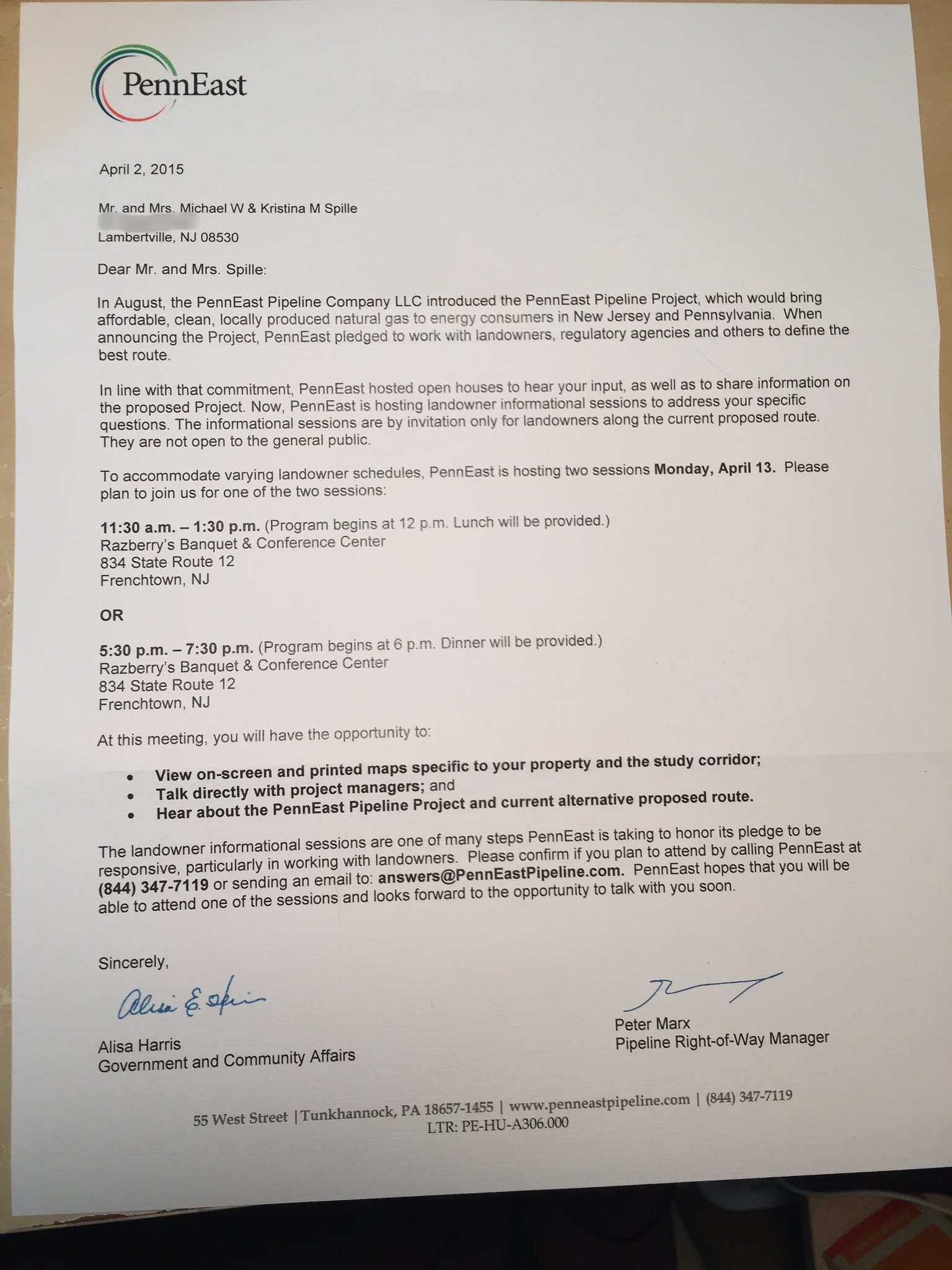
Monday PennEast meeting in Frenchtown

For all those who’ll be attending, I’ll be going to the evening session. I certainly can’t make it to Frenchtown for a lunch session and I doubt many others would be either. I’ll be there early and will have materials to hand out. I’ll be the tall chubby fellow with a John Deere hat on 🙂

See you all there!

The Empire Strikes back?

As part of the FERC pre-filing process PennEast is forced to read through all of the scoping comments entered into FERC’s eLibrary system, and come up with a response to all of them.

Along the way PennEast has acknowledged the mountain of comments that have been received against the pipeline, and has indicated they’re a bit overwhelmed.  However, at the same time they must have noticed that there were damn few pro-pipeline comments beyond the rather ridiculous post cards mailed in by union members.  So they decided to do something about it.

Today a number of comments popped into eLibrary site which are very pro-pipeline.

Christine Kramlich writes:

As a long time resident of Pennsylvania, I have seen this state be great and I have seen her falter, much like America. The number one reason for this is lack of well paying jobs. PA needs this desperately. I am a type of person who will tell you what I really think; you need to get this done and done now!!! We need the jobs to make PA great again instead of leaving a legacy of debt and unemployment for future residents.

Jeremy Horning writes:

I’m writing to express my support for the proposed PennEast Pipeline, transporting natural gas from northeastern Pennsylvania to Pennington, New Jersey. In addition to bringing clean, abundant, locally produced natural gas to meet growing demand in Pennsylvania and New Jersey, the PennEast pipeline also would deliver numerous other benefits, including a $1.6 billion positive economic impact to both states and 2,500 jobs during the construction phase of the project. As a resident of PA and a supporter of clean energy, I’m convinced the project would be positive for our region.

Shane Clark writes:

I think it would definitely benefit no only the company (UGIES) as a whole but also the economic positives for an area that has seen staggering rates of welfare and homelessness. It will also bring a lot of jobs to those who can not find work. This should be approved for the positives of the points I have made as well as the benefits of having cheap and reliable gas service to those in need!

Hmm, well that seems a little odd “benefit no(t) [sic] only the company (UGIES)”, but his grammar is a bit off so we can just chalk it up to that.

Joan Neustadter keeps it simple:

I strongly support the PennEast Pipeline project. Please approve.

Barbara Nawa also keeps it short and sweet:

I support the PennEast Pipeline Project. Thank you.

Joseph W. Jarrow writes:

I support the PennEast Pipeline Project. It is of great value to many communities and businesses alike. I am an employee of UGI Energy services. Thank you for your time.

Whoa, wait, what? An employee of UGI Energy Services? UGI is a PennEast partner and the primary project manager of the pipeline.

If you go through the rest of the comments a few people do self-identify as UGI employees. A bunch do not however, such as the people I highlighted above. Here’s what a simple google search shows about them. In particular their linked in profiles are very enlightening:

Christine Kramlich:

https://www.linkedin.com/pub/christine-kramlich/33/736/b9a

Her job is “Production Services Specialist at UGI Utilities, Inc”.

Jeremy Horning:

https://www.linkedin.com/in/jeremyhorning

His job is “Engineer at UGI Utilities, Inc”.

Shane Clark:

https://www.linkedin.com/pub/shane-clark/65/4bb/b40
His job is “Help Desk Specialist at UGI Energy Services”.

Joan Neustadter:
https://www.linkedin.com/pub/joan-neustadter/38/2a2/76

Her job: “Sr. Contract Analyst – UGI Energy Services, Inc”.

Barbara Nawa:

https://www.linkedin.com/pub/barbara-nawa/64/114/12

She’s a “Executive Assistant at UGI Energy Services, Inc”.

So what we have here is a bunch of UGI employees telling the FERC how great the PennEast pipeline is and they support it. But sadly the majority of them do not identify themselves as employees. Given the number of entries this is clearly an organized effort by UGI to try to make some positive spin on the pipeline. But in reality all it does is make them look even more crooked and deceitful. Do you trust UGI to build this pipeline when this is how it behaves in the pre-filing process?

Another PennEast dog and pony show

So PennEast is going to host yet another set of landowner-only gatherings so they can hawk their pipeline on an unsuspecting crowd without the bother of activists getting in the way with their annoying snippets of truth.

Unfortunately for PennEast, I happen to be one of those landowners. I plan on having business cards made up with all of the local anti-PennEast websites on them, plus will be carrying material for people to read directly onsite. For starters some of the analysis articles from this site will be available.

If you have any material you’d like given to all these people please contact me at thecostofthepipeline@gmail.com. I’ve got a 1/2 ton pickup with a full 8′ bed so I can carry all the material you can give me!

I’m not sure which session I’ll attend, I have a feeling the 11:30-1:30 one will be lightly attended. Should I go for both and risk PennEast barring me from the second one? Or just the evening session?

We are not alone

Sometimes dealing with PennEast and the FERC, and worrying about pipeline routes, and looking at environmental impacts, and researching energy markets, and looking for supporting evidence of various theories, and educating yourself on engineering practices, geological formations, etc etc all becomes a bit overwhelming and you start questioning your sanity. It’s all to easy to just hold your head in your hands and say “Oh lord, why is all this happening?! Why me? This is crazy….”. And I know it’s not just me, everyone I’ve talked to about pipeline issues have had the same feeling to one degree or another.

One thing that helps is to realize that we’re not alone. And I don’t just mean here in NJ and Eastern PA. I mean across the country. It’s not just PennEast that’s messing with our environment and our towns. It’s multiple pipelines around the country that people are fighting, and individuals and organizations all over the country are each learning about (and being sickened by) the FERC and its processes.

Along these lines, one day when I was doing searches in the FERC eLibrary site I decided to do something a little different. Rather than search on our docket, PF15-1-000, I decided to search….all natural gas dockets. I figured I’d see what other people were saying in their own pipeline wars.

A submission on the first page caught my eye immediately. It was entitled “Fix FERC First – Part 6”. It was a treatise on all of the things that were wrong with the FERC. I was intrigued and in the end I ended up reading all 6 parts of the series and contacted the author, Nick Miller. His full document has now grown to 7 parts plus a forward and table of contents and is available below:

https://drive.google.com/file/d/0B512ERL8q-oIdHJ1a21SekFSNWs/view?usp=sharing

Nick lives in Groton, MA, and has a story much like mine. He learned a natural gas pipeline was going to go through is town (Kinder Morgan’s Tennessee Gas pipeline) and started researching it. Over time he learned all about pipelines, and the FERC, and how pipeline proposals sail through the approval process with ease. As he researched more he became increasingly horrified at the broken FERC processes and how the pipeline companies ruthlessly take advantage of it to more or less do whatever they want.

Reading his treatise was a chilling exercise for me because his points are eerily familiar. Replace the words “Kinder Morgan” with “PennEast” and the document would still ring true. It’s amazing how all of the pipeline companies are using the same playbook and the same exact tactics to ram their proposals through the process and dupe the public into believing their for the common good.

Part 1 of his document outlines Nicks’ overall thesis. I’d distill it down to these points:

– FERC is fundamentally broken.
– FERC considers pipeline projects in isolation even when they were clustered close together geographically and in terms of timing.
– FERC lets the market determine direction instead of government dictating policy decisions.
– FERC allows pipeline companies to resort to vague handwaving and slight-of-hand, and will not force them to give the public hard facts.

As we fight the PennEast pipeline, does any of this ring a bell?

Part 2 deals with the FERC’s faulty definition of “need”. He discusses in detail how eminent domain – a gravely serious business – is being ascertained strictly by determining if a company can make money from a proposal. If the answer is “yes” then FERC considers the project justified and gives it the green light. Nick shows how the public is kept out of this process entirely and how manifestly unfair it is to residents and organizations that are affected by this process.

Part 3 goes into more detail about how the FERC colludes with the industry to mislead the general public on infrastructure projects. He lists how Kinder Morgan has engaged in a litany of misleading information and deliberate obfuscation of the truth – and how FERC has stood by and let it happen. Some examples include:

– Made presentations at town meetings where it agreed to provide answers to the written
questions submitted by the town selectmen – and then simply never even attempted to provide
those answers, despite repeated requests for them to do so.

– Filed laughably poor maps from outdated sources

– Represented a 6,000HP compressor station as more or less the same as a 90,000HP one.

– Changed routes and maps without informing affected stakeholders.

– Refused to add additional scoping meetings during extreme snow conditions

– Lied about use of existing right-of-ways, where in fact they will be widening an existing right of way considerably.

– Refused to disclose final location of compressor stations

– Answers legitimate questions with misdirections to irrelevant topics

Anyone involved in the PennEast fight will find these behaviors extremely familiar.

Part 4 of this magnificent document studies in depth just how short sighted FERC is. It goes into detail about the perils of fracking, and fossil fuels in general. He talks about FERC approving every pipeline project in site with no thought to what those pipelines in the ground will mean 30-40 years from now when they go quiescent. It talks about FERC short-changing the long term for short term corporate profits.

Part 5 is entitled “The “R” Is For Regulatory Not Rubberstamp” and is pretty self-explanatory. As we’ve seen in our fight against PennEast FERC mostly just goes through the motions without any real passion or engagement. They are clearly phoning it all in and have no intention of actually doing their jobs and truly regulating the industry’s growth.

Part 6 is a great little diversion where Nick gives quotes from other prominent people who are critical of the FERC. He includes quotes from Robert F Kennedy Jr, Elizabeth Warren and Jim McGovern. I really like the quote from Warren: “I am very concerned about a regulatory agency that is only able to say ‘yes, yes, yes.’ That’s not the job of a regulatory agency.”

Part 7 wraps it up and ties all the pieces together.

I’m glad there are people around the country like Nick who are willing to not only stand up and fight against the pipeline companies and FERC, but who take an enormous amount of time and effort to really research the issues in-depth and make a stand that is amazing for both its depth and breadth. As I said in the opening of this post, take heart people. We’re not alone in this. People around the country are waking up and see the farce that the FERC has become, and they’re determined to do something about. So keep it up and let’s do our part and contribute that noble goal of reforming the FERC and the energy policy in this country along the way.