PennEast partners already contemplating expansion

This a comment filed today from West Amwell Citizens Against the Pipeline.  It talks about FERC improperly accepting PennEast’s marketing language about “collocation” (hint: it’s not), talks about the realities of the real route and how greenfield it actually is.

And finally goes on to point out that PennEast partners are already contemplating expanding the line.  So if PennEast is built, we should look forward to years and years of additional pipelines, looping projects like the Leidy Line Southeast Expansion, Compressor station upgrades and all the rest.

This is not “collocation”.  This is a brand new natural gas super-highway being contemplated that will start out as 4-lanes of hell and then be upgraded to 12 lanes or more in coming years.  All through the most pristine portion of New Jersey and PA you could imagine.


September 8, 2016

Honorable Norman Bay, Chair
Federal Energy Regulatory Commission
888 First Street, NE
Washington, DC 20426
Re: Docket CP15-558-000 – Proposed PennEast Pipeline Project

Dear Chairman Bay, FERC Commissioners and FERC staff,

I am commenting on the PennEast Draft Environmental Impact Statement (DEIS) on behalf of West Amwell Citizens Against the Pipeline (WACAP), which is an intervenor in this matter.

The DEIS states in section 2.2.1, page 2-4:

Where feasible, the pipeline was collocated with existing easements and rights-of-way (e.g., roads and utility lines). About 44.3 miles (26.8 miles in Pennsylvania and 17.5 miles in New Jersey), or about 37 percent, of the 115.1-mile-long pipeline route would be constructed adjacent to existing rights-of-way. 

This language is vague and mis-leading and does not convey the actual characteristics of PennEast’s preferred route. Further, this is not written as a neutral agency evaluating a project in good faith.  Rather, it appears that FERC is furthering PennEast’s own marketing statements and position.

WACAP believes a more accurate description of the route would be:

This is a greenfield route, the majority of which, about 63%, is not collocated with any existing easements or rights-of-way.  In addition, a significant percentage of the areas where collocation is achieved occurs outside of existing uses of the easement. So the actual environmental impact is far greater than a 37% collocation would normally indicate.

In other words, the route is green field, is not predominantly collocated, and there are problems in many areas where collocation is achieved.

Specifically, there are many areas where PennEast is technically all or partially within a utility easement, but the proposed construction and final ROW are wholly outside of the portion of the easement that is actually used by the utility.  For example, on Baldpate Mountain (a highly sensitive ecological environment), a very wide utility ROW exists on the order of 275’ wide.  However, the existing maintained “cut” for the power lines is only 100’-125’ wide.  PennEast will be wholly outside of the existing cut.  So while this is technically colocation within an easement, it is not colocation in terms of environmental impact.  The construction and on-going operation will be effectively in a greenfield area.

The same is true of the entire route through West Amwell Township.  PennEast’s ROW is a minimum of 90’ away from the high voltage power lines, and thus the existing power line cut will be doubled or more.

The EIS must be changed to reflect the reality of the route.  This is not a seemingly benign, collocated route with minimal damage to the environment.  This is a greenfield, brand-new route through our region.

Further, the DEIS fails to consider future development that may occur if this greenfield route is approved.  All impacts are assumed to be limited to those of PennEast, and no follow-on projects.  However, experience has demonstrated that once a route is established, other pipelines, looping projects such as the Leidy Line Southeast Expansion, etc inevitably follow.  The DEIS must include this factor in its determinations.  This is a new major natural gas utility corridor that is being contemplated, and the DEIS should reflect that.

This is also not a theoretical exercise.  One of PennEast’s owners, South Jersey Industries, have already indicated that they are contemplating expansion to the line.  During the SJI Q1 2016 Earnings Call with analysts, SJI CEO and President Michael Renna stated:

First, yes, we do have a business development group that reports up through Greg Nuzzo, so we’re evaluating different opportunities in the space. I think that there are opportunities for expansion of PennEast potentially down the road, as well. So I’m very bullish on the opportunities that we have in front of us.

http://seekingalpha.com/article/3972872-south-jersey-industries-sji-ceo-mike-renna-q1-2016-results-earnings-call-transcript?part=single

This is a 20% owner of PennEast stating on the record that they are contemplating expansion of PennEast even before the initial construction has been approved.  Given that one of PennEast’s owners has publicly stated that they are already considering expansions to PennEast, the DEIS must consider this impact in the DEIS.

Just because the PennEast owners are structuring their construction in stages does not mean that the environmental impacts can be segmented.  PennEast’s intentions here are quite clear.  They are attempting to open up a new major natural gas pipeline route that will be expanded many times in coming years, just as other pipelines are expanded.  The DEIS must take this into account when considering the impact to our region.
What size pipe will you be served?

Safety is, of course, a big concern for those who will be potentially living near gigantic high-pressure natural gas pipelines like PennEast. But, as I’ve documented before , how safe the pipe will be for you depends on exactly where you live. Thanks to the “Class Location” system, if you live out in the beautiful country side with few neighbors, you’re going to get a pipe that’s less safe. If you live in a city you’ll get the strongest possible pipe.

My post above talks about many of the details of how Class Location works and the safety “features” it defines. But one of the things not mentioned there is exactly how thick the pipeline will be for those locations. Which is ashamed – having a hard number help many people understand these things better. So let’s get those hard numbers out there!

What The Thicknesses Are

Pipeline thickness varies depending on the quality of steel being used (in terms of what’s called the yield strength of the material , the envisioned maximum operating pressure, the diameter of the pipe, and the safety factor associated with your class location. Fortunately we know all of these values for PennEast:

Yield Strength 70,000 psi (X70 pipe)
Operating Pressure 1,480 psi
Pipe Diameter 36”

And the “design factor” based on class location is as follows:

Class 1

Class 2

Class 3

Class 4

0.72

0.60

0.50

0.40

What this means is that Class 1 locations have the pipeline operating at up to 72% of its safety margin.  Class 2 locations will operate at 60% of the safety margin.  Class 3 is at 50% of safety margins.  And Class 4 is at 40% of safety margin.

Now, as a practical matter you can’t vary the pressure of the pipeline, and you’re not going to generally vary the steel or diameter either, so what class location affects is the pipeline thickness.  The lower your class location, the smaller the thickness of the pipe.  Here’s the formula for figuring out what thickness should be used:

Thickness = (Max Pressure * Pipe Diameter) / (2 * Yield Strength * Design Factor)

Plugging in the numbers for PennEast, we have:

Thickness = (1480 psi * 36″) / (2 * 70000 * Design Factor)

And finally with this we can show the thickness based on Class Location:

Class 1

Class 2

Class 3

Class 4

0.529

0.634

0.761

0.951

As you can see, class location has a HUGE impact on thickness.  Class 1 pipe will be a hair over 1/2″ thick.  Class 2 pipe is almost 2/3″ thick.  Class 3 pipe is just over 3/4″ thick.  And Class 4 pipe is nearly 1″ thick.

How To Figure Out Your Class Location

You can find out your class location from the PennEast application maps.  If you go here:
http://www.pipeinfo.org/formal-application

…on the right side top of the page you’ll see a section entitled “Pipeline Mainline Maps (Appendix C). These are the construction maps for PennEast. It looks like this:

C2 – Mile Marker 0 to Mile marker 5
C3 – Mile Marker 5 to Mile marker 10
C4 – Mile Marker 10 to Mile marker 15
C5 – Mile Marker 15 to Mile marker 20
C6 – Mile Marker 20 to Mile marker 25
C7 – Mile Marker 25 to Mile marker 30
C8 – Mile Marker 30 to Mile marker 35
C9 – Mile Marker 35 to Mile marker 40
C10 – Mile Marker 40 to Mile marker 45
C11 – Mile Marker 45 to Mile marker 50
C12 – Mile Marker 50 to Mile marker 55
C13 – Mile Marker 55 to Mile marker 60
C14 – Mile Marker 60 to Mile marker 65
C15 – Mile Marker 65 to Mile marker 70
C16 – Mile Marker 70 to Mile marker 75
C17 – Mile Marker 75 to Mile marker 80
C18 – Mile Marker 80 to Mile marker 85
C19 – Mile Marker 85 to Mile marker 90
C20 – Mile Marker 90 to Mile marker 95
C21 – Mile Marker 95 to Mile marker 100
C22 – Mile Marker 100 to Mile marker 105
C23 – Mile Marker 105 to Mile Marker 110
C24 – Mile Marker 110 to Mile Marker 115

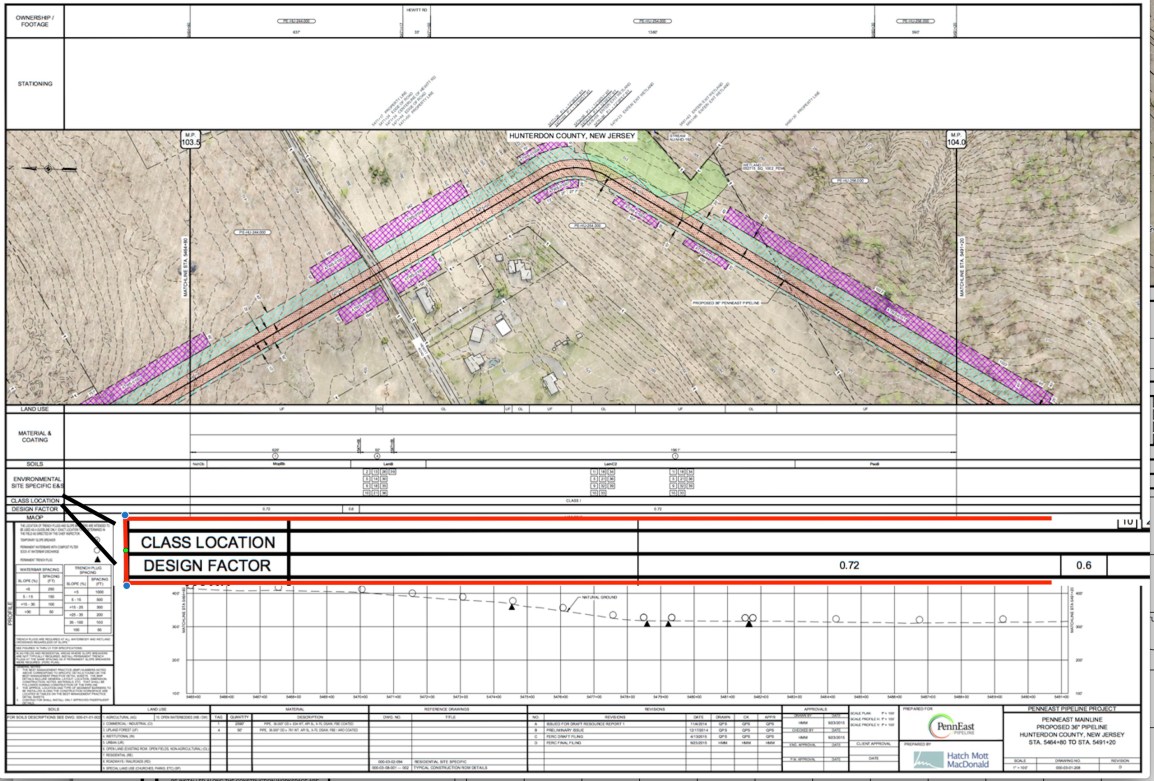
These are maps broken down by PennEast Mile Marker.  If you know your mile marker, go into the appropriate file, and you’ll find the construction maps for you site.  Here’s mine:

classlocationsconstructionmaps

The top part of the map shows visually what’s going on.  Then there’s a bunch of lines below that.  Those lines are characteristics broken down by where they are on the map.  I’ve called out two of them – they are Class Location and Design Factor.  These are what PennEast consider to be the Class Location for that portion of the map, and the Design Factor as well.  They change the Design Factor in some cases separately from the Class Location.  In this example, I am listed as Class 1 (oh boy!) with an associated design factor of 0.72.  But a little sliver is shown wth a design factor of 0.6.  That sliver is Hewitt Road, they use slightly better pipe under roads.

So find your own map and you can find the class location and design factors for your area.

Don’t know your mile marker?  Email me your address at “thecostofthepipeline@gmail.com” and I’ll let you know.

Hey I Thought PennEast Wasn’t Using Class 1 Pipe?!?

So did I.  But the construction maps do have Class 1 all over the place.  More importantly, they specify a design factor in the construction maps, and those design factors match up with Class 1 ones.

PennEast should be called out for claiming they are using Class 2 as a minimum in all locations when their actual construction plans call for Class 1 in many sites.


The Dense web of financial interests

The Lambertville Pipeline Committee met with a representative of U.S. Senator Cory Booker this week to talk about the city’s concern about PennEast in general, but also specifically about the impacts to the drinking water site and Suez.

I won’t go into a lot of detail, we were promised some help and hopefully that will go somewhere.  But it was clear that the Senator would not come out against the pipeline, a position that we knew going into the meeting.

Even so, it’s unsettling when you figure out why various politicians won’t come out against projects. It seems you always just have to follow the money.

One of the people associated with Senator Booker is the Rev. M. William Howard.  When Mr. Booker was Mayor of Newark, Howard was tapped to lead his transition team.. In fact, the Senator considers Mr. Howard a mentor to him.

As it turns out, Rev. Howard also sits on the Board of Directors of New Jersey Resources:

http://www.njresources.com/news/releases/2005/njr/05-78newboardmember.asp

New Jersey Resources is of course a 20% owner in PennEast, and its subsidiary New Jersey Natural Gas is the largest customer with 18% of the total volumes going to them.

In his role of director, Rev. Howard has been granted several thousand shares of stock which are currently valued at close to $470,000 at Friday’s close. He recently sold 2,000 shares to net $70,000 in cash.

http://www.sfhfm.org/new-jersey-resources-corp-njr-lowered-to-neutral-at-janney-montgomery-scott/

There is no impropriety here on the surface, unlike others such as Thomas Bracken and his endless promotional campaign for PennEast without disclosing his own $1.5 million interest in it.

But even so, this dense web of financial interests is troubling. Whenever you wonder about a politicians’ position on an issue that seems to be a little out of character or somewhat unusual, it seems all you have to do is follow the money, and all will be made clear.

A teamster weighs in on the pipeline

The transcripts from the scoping meetings is starting to come out, and I’ll highlight a few to give an idea of what people were saying.

First up, we have Carmine Caruso, a teamster for local 469, which is based in Hazlet, NJ. As it happens, I grew up a stones throw from Hazlet in Matawan, NJ. It’s quite a ways from Hunterdon County 🙂

Anyway, here’s Carmine’s testimony to FERC:

CARMINE CARUSO: My name is Carmine Caruso,
15 C-A-R-M-I-N-E C-A-R-U-S-O. I am a Teamster, Local 469.
16 I’m representing the pipeline. It creates jobs. It’s very
17 safe and secure. I work for a lot of different contractors
18 on the pipeline, and safety is one of the main objects of
19 that goal, to put pipe in the ground and put it in safe and
20 keep the environment safe.
21 Also when the job is finished, it creates jobs
22 for the different Locals that are in the area. And also
23 some people get excited about you’re not going to do this
24 right, you’re not going to do that right, they use the wrong
25 kind of pipe. Everything is engineered out and spec’d out
1 to 100 percent on everything what they do. And I can’t
2 elaborate no more than that on it.
3 And hopefully everything goes through and safely
4 and there’s no issues and hopefully they put a lot of guys
5 to work. And do you have a question or anything? Nothing
6 to elaborate on. I don’t know why people get up
7 about the pipe going in the ground. You want to
8 gas on, you go to the gas stove to turn your gas
9 want to have heat, why would you want oil? Oils in arms turn your on, you
10 contaminate. It goes in the ground. Everything’s getting
11 rid–they’re trying to get rid of oil, you know, especially
12 oil burners. Natural gas is the way to go as far as I’m
13 concerned.
14 Everybody says thin wall pipe. It’s not true.
15 It’s not true. Totally wrong. But everybody has their own
16 opinions, so… I worked pipeline for, I’m a 36-year career
17 man. I have 36 years. I’ve worked probably about 22 years
18 of pipeline. Never had an issue. Every Saturday there’s a
19 hour-and-a-half safety course we have to take. And every
20 morning there’s a tool shop, toolbox talk, I should say, any
21 issues, anything like that.
22 That’s about all I have, you know. Hopefully
23 everything goes smooth and everything goes through, and
24 that’s all I have. Okay? Thank you very much.

I don’t begrudge Carmine his opinions, but it is pretty clear that he trusts the judgements of those above him to keep himself, and everyone else safe.  If that were true I think we’d all have a lot less issues with projects like PennEast.

But we know it’s not.  We know all pipe is not created equal, and FERC and PennEast is fine with us getting the cheapest and thinnest pipes possible because we are a rural community.

We know that most construction jobs will be outsourced to other states, and that close to zero people from Hazlet, NJ (or anywhere else in the state) will be employed on it.

We know safety monitors have been fired from pipelines because they complained about conditions.

We know that we have more than enough natural gas pipelines to already service this state, and we don’t need any more – so why are you talking about oil?

We know everything is not “100% speced out” – in fact, in PennEast’s latest filings they are asking their contractors to change the plans on the fly to suit their own mood and judgement, and that such changes could severely impact C1 streams.

But don’t blame Carmine, and don’t blame the Teamsters for this.  They are just looking for jobs and to feed their families.  What we need to do is educate them on how their employers aren’t doing any of these things, how they are lying to them about jobs, and how to transition from dubious fossil fuel companies into jobs that will pay in the long term.

This is Hilarious

http://interfaxenergy.com/gasdaily/article/21740/penneast-pipeline-wins-backing-from-utility-company

You won’t be able to read the details unless you’re a subscriber, but it doesn’t really matter.  The big news is that a major utility company in New Jersey, South Jersey Gas, has backed the PennEast pipeline project.  Exciting, right?  You can read their full submission to FERC here:

http://elibrary.ferc.gov/idmws/common/OpenNat.asp?fileID=14340008

In the glowing recommendation, South Jersey Gas President Jeffrey E. DuBois talks about the “much needed” gas from PennEast, how it will “improve natural gas reliability”, and even threw in a bit of scare mongering about the polar vortex winer and how you could be paying 25x your current costs if PennEast doesn’t ride to the rescue and save us all.

But wait, then curiously he goes on to say:

The PennEast planning team continues to solicit input on the proposed route even though they have already evaluated more than 100 route options and implemented multiple route modifications to advance safe pipeline construction and operations while minimizing impact on the community and environment“.

You know, it almost sounds like Mr. DuBois is not just a buyer on the pipeline, but is an insider and knows about internal PennEast planning. How could that be?

Oh, yeah, right, I forgot. South Jersey Gas is owned by South Jersey Industries, who owns 20% of PennEast Pipeline Company LLC.

So when you look behind the curtains, what Mr. DuBois is really excited about is sending tens of millions of dollars a year of new revenue to his bosses up at South Jersey Industries.  And presumably getting compensated quite nicely for the favor in turn.

PennEast lied to Lambertville Water Company, Imperils Lambertville’s Water Supply, and Lied to FERC

So the Lambertville Pipeline Committee has been busy since it was formed just a few weeks ago.  One of the big concerns with Lambertville is the potential impacts to their main water supply, which is the Swan Creek Reservoir next to Route 518 in West Amwell.  That Reservoir and water treatment plant is now owned by a company called Suez (used to be United Water, and a bunch of other companies before that).

So we naturally met with Suez representatives to get their take on things.  A full FERC comment on it is going out and is available at the link below:

https://s3-us-west-2.amazonaws.com/wacapresearch/SuezLambertvilleComment.pdf

We went into the meeting knowing that Suez was mentioned as being a source of water for hydrostatic testing, and assumed they were in bed with PennEast in one way or another.

Boy, were we wrong.  Suez was duped just like the rest of us have been.

Some of the highpoint from the meeting:

  • Suez had only been contacted once by PennEast, and never again since then
  • PennEast lied to Suez.  PennEast said there would be no blasting anywhere near the site.  Yet their recent data dump shows the site as one of those where blasting would be probable.
  • PennEast lied to Suez about drilling too.  They told Suez they would be drilling far below the site and so wouldn’t impact any of their infrastructure.  In fact they’re open trenching that site.
  • Oh, and by the way, the pipe between the reservoir and water treatment plant is where they are open trenching, and it’s only a few feet below the surface.  Say goodbye to your water, Lambertville.
  • PennEast lied about contacting Suez about a source of water for hydrostatic testing.  Suez reps vehemently denied having talked to PennEast about it at all.
  • The DEIS naturally makes no mention of Suez or the reservoir or drinking water supplies, other than the lie above about PennEast using the reservoir as a water source for hydrostatic testing.
  • The reservoir dam is a “High Hazard Dam”.  It’s failure would almost certainly lead to loss of life and/or extensive property damage in Lambertville and West Amwell.
  • Did I mention that the plans as they exist today would destroy Lambertville’s main source of drinking water?

So we should all cheer up.  It isn’t just us that PennEast messes with.  They do the same thing to critical drinking water infrastructure companies, too.