10 Questions for Ron Shapella, Candidate for West Amwell Township Committee

Ron Shapella is running for the Township Committee in West Amwell as well, and also agreed to be interviewed here on how he plans to fight PennEast if he were elected.


1) Why are you running, and why should people vote for you?
Ron: My experience includes being directly involved in township issues going back to 2000, when I was on the Planning Board as it began revising the township Master Plan.  I also have experience in reviewing school budgets, since defeated budgets go to the Township Committee for review.  That happened a few times when I was on the Township Committee in 2004 and 2006-09.  My experience would go a long way toward preventing the roller coaster taxpayers found themselves on this year where taxes went down during one quarter and back up again in the most recent quarter.
2) What is your position on the PennEast pipeline?  Are you for it, against, it
neutral, or something else?
Ron: I am adamantly opposed to the pipeline.  I’ve posted the letter on my campaign Facebook page that I wrote and sent to FERC in April pointing out that when we revised the Township Master Plan, this kind of industrial intrusion into West Amwell was exactly what we wanted to prevent.  It has no place in a largely unspoiled rural setting like West Amwell, or any of our neighboring communities, for that matter.  There are only a few places in West Amwell that are served by natural gas, so we will not benefit.  Penneast has not been honest with people in West Amwell and has tried to avoid public accountability.  For example, what happens at the end of the 10-15-year expected lifespan of the proposed pipeline?  Does it get excavated all over again?  I also hear it might be used to transport oil at some point, which is a nightmare scenario for West Amwell.
3) What do you think your township has done right so far in dealing with the
Pipeline company? And where do your think there could be improvements?  
Ron: The Township has been responsive and has hosted a number of public meetings,  It is on the record as opposing the pipeline.  On the other hand, I was very disappointed when I learned at a recent public meeting that our mayor had met privately with Penneast representatives.  There is absolutely no way to justify something like this.  Supposedly, Penneast doesn’t want any more public meetings because they have to face too many opponents of their disastrous plan.  Well, too bad for Penneast, I say.  Any meeting with Penneast or anyone else who seeks to do business in West Amwell must be done as part of a publicly noticed meeting that West Amwell residents are able to attend.  I was also told that it didn’t matter if the mayor attended this meeting, that he is only one of three who would have to make a decision.  That is irrelevant and ignores the divide-and-conquer goal of Penneast.  They want to lobby our elected officials one-by-one, and try to soften them up, so that when decision-time comes they might be more likely to get  the outcome they want.  If I am elected I will always demand that meetings like this be subject to the state’s Open Public Meetings Act, in that they be properly noticed and open to the public.
4) What is your opinion on PennEast’s purpose and need?  Will this be a
net-benefit to people in NJ?
Ron: As I said before, West Amwell will see little if any benefit from the pipeline, and I believe most of the natural gas it transports will not meet the needs of New Jerseyans in any significant way, except for Penneast shareholders.
5) If you’re against the pipeline, how do you plan on fighting it going into
PennEast application period?
Ron: The debate period has opened on this disastrous proposal.  I will remain engaged until the end.
6) What can residents do to get more involved and help?
Ron: There is a process that is governed by federal regulations, which is outlined by FERC.  It is a complicated process, but we can’t let up on the pressure now.  West Amwell residents should also continue to look to our Environmental Commission, which has been consistently out front in opposing the pipeline.
7) How can township committees help residents that worry about water safety
issues, septic system worries, construction issues, traffic impacts, etc etc
that are anticipated if this project is approved?
Ron: All of these topics are thoroughly covered by local, county and state regulations covering land use and public health.  West Amwell has put in place several protections governing large-scale development in the last 10 years and I hope that these remain in place.  I will always work to keep them in place and I hope that will be the case no matter who wins on Nov. 3.
8) How can townships collaborate better to fight the pipeline?
Ron: The Environmental Commission in West Amwell worked very closely with the Delaware Riverkeeper on the Penneast issue, as did Hopewell and Delaware townships.  We were all pointing in the same direction, which was across-the-board opposition to this disastrous pipeline plan.
9) Can townships work more closely with state and federal agencies on issues
such as this one?
Ron: It’s not always easy to find out what the state and feds are planning to do.  I think it’s important to know what we want to do in advance and what kind of community we want so we can quickly tailor our approach accordingly.
10) Any closing remarks
Ron: It’s is vital that everything be handled in a publicly visible way.  Public accountability at every level is so important.

10 Questions for Stephen Bergenfeld, Candidate for West Amwell Township Township Committee

Steve Bergenfeld is running for the West Amwell Township Committee, and graciously agreed to be interviewed on his views about the PennEast pipeline, and how he believes the Township can help fight it.


You can visit his campaign Facebook page including endorsements here:

https://www.facebook.com/Steve-Bergenfeld-for-West-Amwell-Township-Committee-749356051836426/

1) Why are you running, and why should people vote for you?

Steve: I have decided to run because I strongly believe that I have a lot to offer West Amwell Township.

I have established and grown several business, starting at the age of 17 to the present. I will use my business skills to improve West Amwell’s finances, as I am well versed in Township matters having served on the Finance Committee since its establishment in 2010, and on the planning board since 2009. I have also been on the other side as an applicant in multiple municipalities, so I have both perspectives.

I believe that West Amwell needs a fiscally conservative minded person on the Township Committee to hold spending and overregulation in check. We need to consider carefully before proceeding on any course of action that may take us back to government mismanagement. I will respect traditions and policies that have been developed over many years by our predecessors.

2) What is your position on the PennEast pipeline? Are you for it, against, it neutral, or something else?

Steve: I am totally against the proposed pipeline. Other than some property tax revenue there is no benefit to the Township or other municipalities in NJ, only risks. I feel that there are serious risks to potential groundwater and surface water contamination, and contamination of private wells. The use of eminent domain for a private enterprise of arguable need is deeply disturbing and the compensation offered to effected landowners is inadequate. The fact that preserved farms are not exempt from this taking is even more disturbing.

3) What do you think your township has done right so far in dealing with the Pipeline company? And where do your think there could be improvements?

Steve: Our Township passed a Resolution opposing the pipeline and appointed a very strong Pipeline Committee, which I fully support. The Township, with major input from the Pipeline Committee, hosted a community wide meeting last year to provide information and advice to residents. We continue to update our residents with information. The Pipeline Committee and the West Amwell Citizens Against the Pipeline group are mostly responsible for this dissemination of information.

[full disclosure: I am the founder of the West Amwell Citizens Against the Pipeline -Mike]

4) What is your opinion on PennEast’s purpose and need? Will this be a net-benefit to people in NJ?

Steve: Very few West Amwell homes and  businesses use natural gas due to our low density development which make delivery impractical.  The pipeline would not change that, so there really is no local benefit.  There may be a need for more gas elsewhere in New Jersey but if so there are many existing pipelines to deliver to those areas.

5) If you’re against the pipeline, how do you plan on fighting it going into PennEast application period?

Steve: I will work very closely with our Pipeline Committee and will stand with and work with their recommendations going forward. They have my utmost respect and I will support their recommendations. I will work closely with our neighboring townships, as we need to provide a united front.

6) What can residents do to get more involved and help?

Steve: Now that Penneast has filed their application with FERC the process has entered a new, more formal phase.

Residents can apply to FERC to be an Intervenor and affected property owners can continue to deny survey access for PennEast. Residents should contact the Township Clerk, Lora Olsen, 397.2054 for updated information, or the Pipeline Committee chair, Cathy Urbanski, 397-8459.

7) How can township committees help residents that worry about water safety issues, septic system worries, construction issues, traffic impacts, etc etc that are anticipated if this project is approved?

Steve: The Pipeline Committee and the Environmental Commission as well as the Township Committee and Board of Health will work with residents with these issues

8) How can townships collaborate better to fight the pipeline?

Steve: We all must work together and provide a united front.

9) Can townships work more closely with state and federal agencies on issues such as this one?

Steve: We must collaborate our efforts with State and Federal Agencies.  We will continue to work with the NJDEP as per their permitting process.

10) Any closing remarks

Steve: Thank you very much.

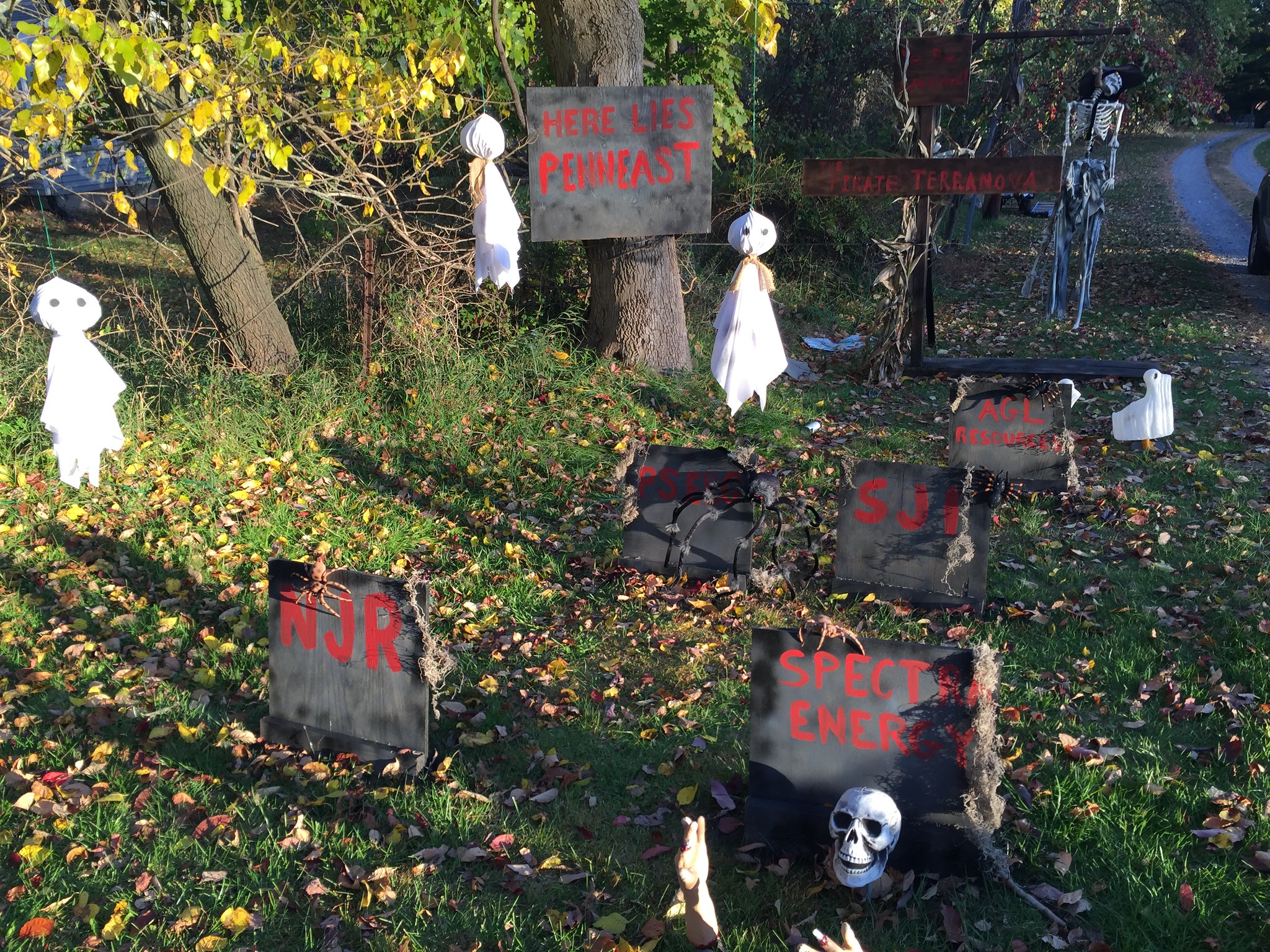
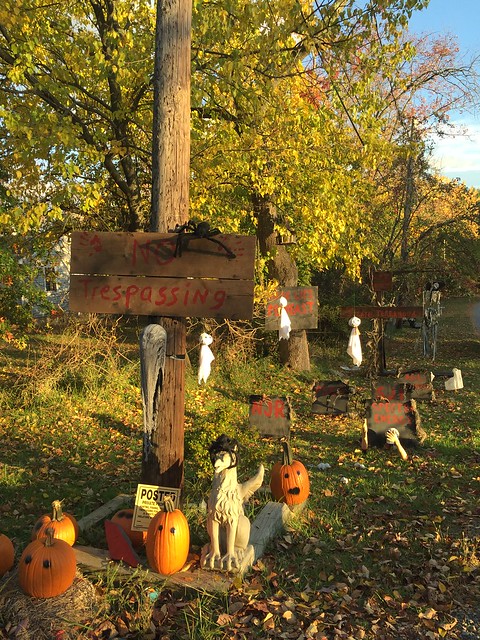
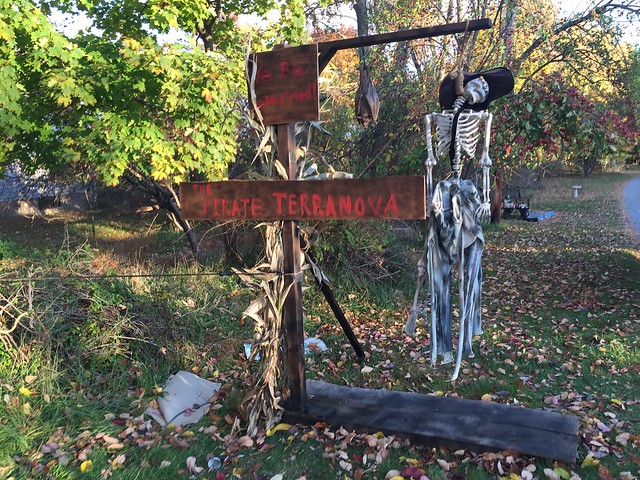
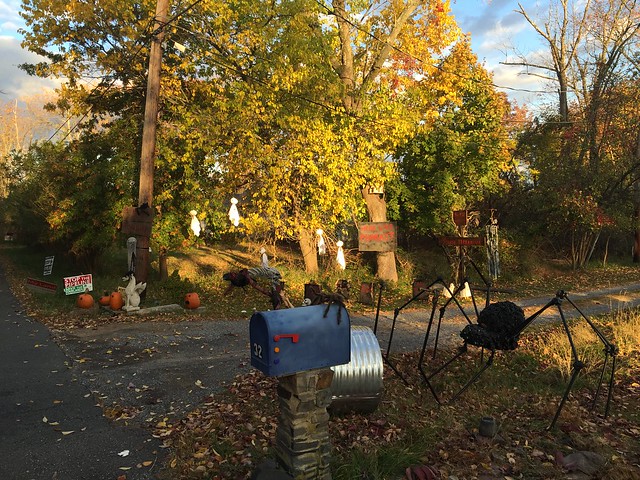
Ye Be Warned!

Once upon a time a terrible scourge came upon a peaceful people in a distant river valley.  Pirates and marauders had been pillaging the upper reaches of the regions for years; distant tales of horror and mayem had reached the river valley.  But the violence had as yet left them untouched, and as it was seen as a far away land, the cries of dismay and woe went unlistened to, and unheeded.  The valley dwellers lived in a peaceful harmony and went about their days, ignoring the deadly peril that would soon be upon them.

That peace, of course, did not last. And one day the maurders did indeed sweep down from the north, seeking new roads to move their plunder to exotic locales across the ocean.  They attacked the villages, intent upon raping the land, scouring the woodlands, and leaving an ugly scar of waste and destruction in their wake.  The valley dwellers appealed to their magistrates, their captains and lords; and though the those great men and women fought valiantly, their efforts went for naught.  For the pirates had bribed the court for the favor of the King, and his gaze went askance to other matters as the maurders willed it to be. And the fear grew, and the pirates grew bold, and there was much despair.

But just as things looked bleak, when the dark leader was poised on the brink of victory, a curious thing happened.  The valley dwellers  rallied amongst themselves.  They banded together and formed a new citizen union to resist the raiders, to push them back, to break them up and force them not just from their lands, but from everyone’s lands.  To utterly destroy the threat forever.

These were not heroes. There were no great knights on chargers, no heroines of legends before. There were no magic swords, no spells to cast. They were simple farm folk, people of the land. But they learned a great secret that gave them strength, and hope. That even a simple man, defending his land, his honor, and his family, can be stronger than a thousand knights on chargers. And that should the need be great, and the cause be just, that even the meek can be mighty.

The war was a dark and destructive one, with many terrible casualties on both sides.  The valley dwellers threw down their homes, their lives, and the very future of their children in the path of teaming hordes.  They risked all in defense of that that they held dear and true in their lives. They made a final stand against arrayed strength of that terrible host.

And though the pirates forces had all the weight of their kind with them; though they had bought the king and his court; though the despair hung heavy over all who defended their home steads, the valley dwellers held fast.  They held fast, and tightened their belts, and braced themselves for the rush.

AND THEY BROKE IT.

And then, amidst a great cheer, they scattered the enemy forces, and routed them back over the river, and destroyed their armies utterly.

The victors hunted the leaders of the bands of pirates, tracked them and brought them each in turn to justice.  And when the last was captured – the dread pirate himself brought in chains, and the court brought their justice, and his fate sealed – when the last remnant was done, the citizens of the river valley left a sign for any future marauders who would dare cross swords with them.

The host of each great pirate band was put to their doom, and sealed therein; their wraiths can be seen above their graves at night when the moon is full.  The vermin and parasites and crawlers of the night are disturbed at these times, and teem through their tombs.

And the original one, the highest of them all, the instigator and schemer: his remains were left to stand for all time as warning to all. Left to say “Pirates, try our walls and our arms, and this shall be your fate”.

YE BE WARNED.

10 Questions for Sam Thompson, candidate for the Delaware Township Township Committee

Over the next couple of weeks I’ll be doing interviews with local candidates to get their stance on the PennEast pipeline, how they intend to deal with it and how they can help us win.  If you have a candidate you want me to interview , shoot me an email at thecostofthepipeline@gmail.com.

First up is Sam Thompson, who’s running for one of the open Township Committee seats in Delaware Township.

1) Why are you running, and why should people vote for you?

Thompson: I have run for office before, and after 4 losses I decided that I could be of service in other ways. A little over a year ago I heard about this pipeline and I began to get involved. By February I was given responsibility by our township’s Pipeline Subcommittee for supplying scoping questions about pipeline safety.  I also spoke during one of the FERC scoping sessions.

It was clear to me by then that our township needed a boost in its efforts to fight the pipeline. So, with the encouragement of many people in my Township, I entered the race.

In addition to the amount of information I have learned about this pipeline project, I also have a good deal of experience with project accounting and budgeting. After reviewing our township budgets from the last few years, I believe Delaware Township needs a new approach to managing its finances. My educational background in analysis and my problem solving skills gained over my 25+ year career in IT will be very valuable in fixing our financial issues.

2) What is your position on the PennEast pipeline? Are you for it, against, it neutral, or something else?

Thompson: I oppose the PennEast pipeline project for a multitude of reasons, primarily that a private company can use eminent domain for its own economic gain.

3) What do you think your township has done right so far in dealing with the Pipeline company? And where do your think there could be improvements?

Thompson: I think our township was wise to create a pipeline subcommittee and give it a very strong leader.   I wish our township committee would speak with a stronger voice in opposition to the pipeline.

It is my goal to change that.

4) What is your opinion on PennEast’s purpose and need? Will this be a net-benefit to people in NJ?

Thompson: I see no real purpose for the pipeline. PennEast has not proven there is a need for this gas in NJ (or PA, NY, DE for that matter).

5) If you’re against the pipeline, how do you plan on fighting it going into PennEast application period?

Thompson: The fight needs to be multifaceted:

  • Putting political pressure on FERC by engaging our members of Congress who represent this area
  • Continuing to support affected residents with environmental, historical, economic information specific to their property
  • Engaging FERC directly as intervenors
  • Working with our state representatives to continue encouraging NJDEP to stick its guns regarding the permitting process.

6) What can residents do to get more involved and help?

Thompson:

  • Sign up as intervenors
  • Deny PennEast survey access
  • Continue outreach to their elected representatives
  • Assist affected property owners to gather any survey information that would impact the EIS
  • report any suspicious surveying activity immediately

7) How can township committees help residents that worry about water safety issues, septic system worries, construction issues, traffic impacts, etc etc that are anticipated if this project is approved?

Thompson: Please see my answer to question 8.  I believe these questions are intertwined.

8) How can townships collaborate better to fight the pipeline?

Thompson: Each township has been working over the last year to collect information about how to deal with impacts from this project. We should be able to combine all of this information to provide a “database” for all of the communities along the pipeline’s path.

  • Residents with questions and concerns would have the benefit of this combined wealth of information.
  • Townships can also align on a very consistent message to county, state, and federal officials and agencies.
  • While staying away from endorsing private services, this database can include contacts for experts who can answer questions about water, septic, etc..

The model used by the XXCAP organizations [Citizens Against the Pipeline] is a good one. Each of us knows our localities best, but when there is a resource that can help beyond a local border, it is shared (such as intervenor training). If we stop the pipeline in one town, we stop it in all towns.

9) Can townships work more closely with state and federal agencies on issues such as this one?

Thompson: The approach to this fight is proving to be an excellent model for how townships can engage directly state and federal agencies. It is also a model for showing how townships can work together to monitor said agencies and hold them more accountable.

10) Any closing remarks
Thompson: If you have not registered as a FERC intervenor, time is growing short.

Please write your state assembly people and senators and ask them to support DEP in sticking to its existing procedures for reviewing permits and to disallow any data from PennEast that has been obtained illegally.


Note: you can find out information on what intervening is and how to do it at:

http://pipeinfo.org/intervene


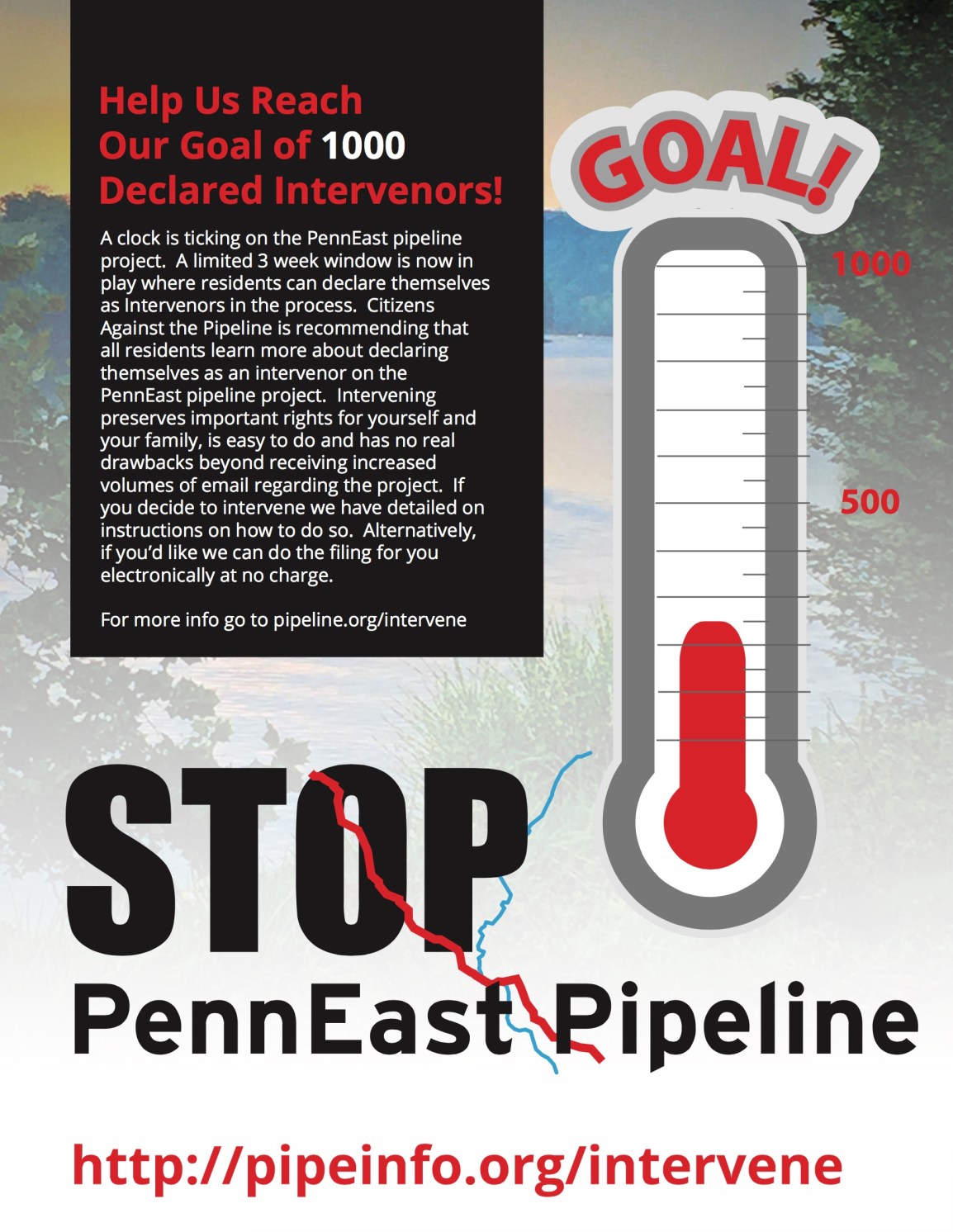
Join us as one of the thousand

Join us as one of the thousand. Protect your legal rights, preserve your right to be heard, and become an intervenor on the PennEast pipeline project. Our goal is to have 1,000 people and organizations filed as an intervenor by the October 29th deadline.

Spread the word, and ensure you and your neighbors don’t get locked out of the FERC process.

Join the thousand and make a difference.  Visit http://pipeinfo.org/intervene to find out how.