Who’s buying the PennEast gas?

So how can PennEast justify this pipeline?  We already seem to have enough natural gas.  The whole state of NJ uses around 1.8 billion cubic feet a day on average across all consumer types (residential, electrical, industrial, transportation).  This pipeline, at 1 billion cubic feet a day, could power more than half the state all by itself.  So how could this work?


Who’s Buying the Gas?

Well, there are a few different ways.  First there’s the Purpose and Need justification they have to provide to satisfy eminent domain. They have to prove that this project will provide material benefit to the people of NJ and PA that outweighs their taking our land via the government.  In this case their purpose and need is that several companies are willing to buy natural gas from the pipeline, and that they will use it to benefit businesses and consumers in Eastern PA and NJ.

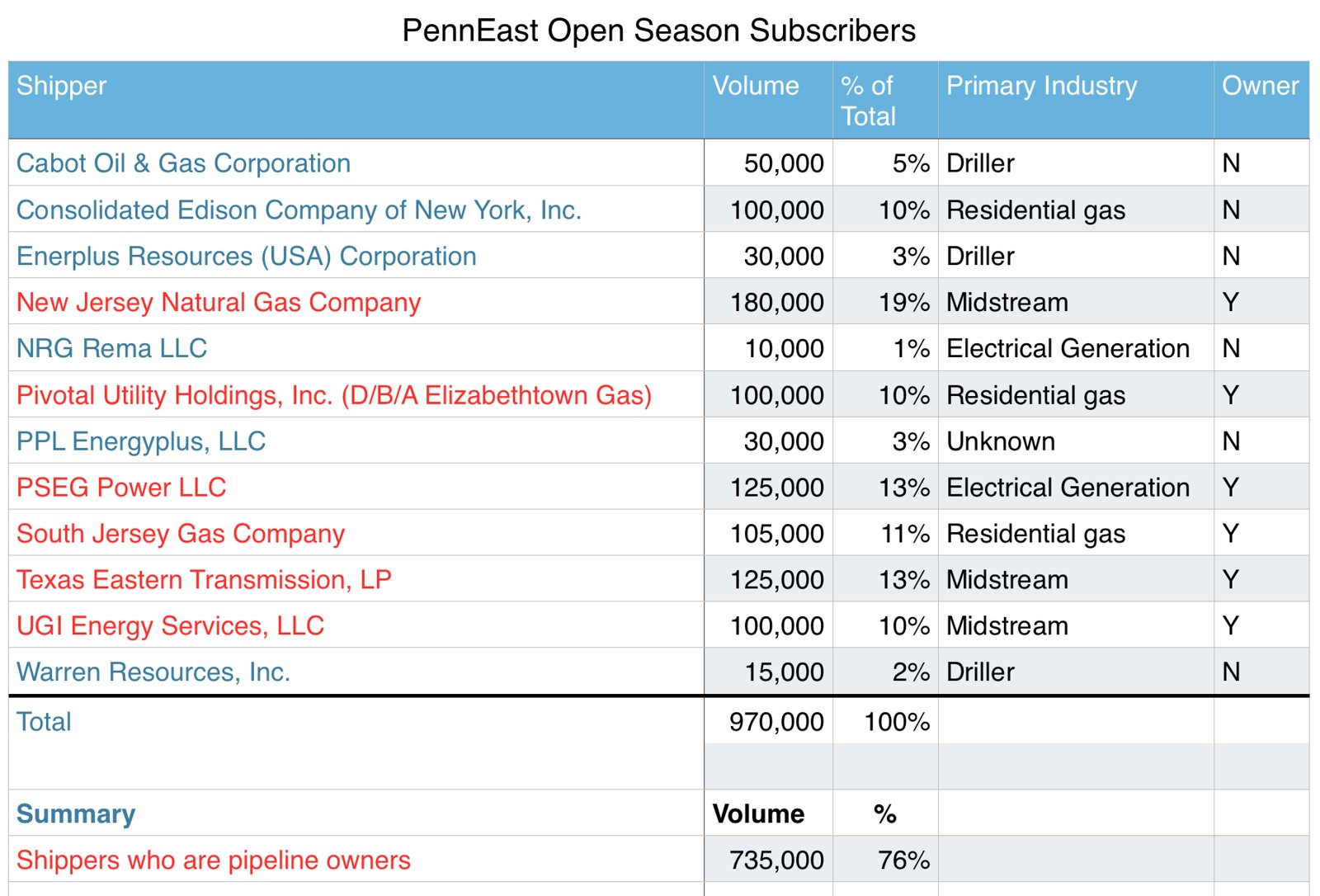
The reality is a bit different though.  In PennEast’s most recent government filings they have included the list of “open season” subscribers who have pledged to buy gas from PennEast.  These are shown below:

This table shows each subscriber to the pipeline, how much volume they’ve committed to, what percentage of the total that represents – and most critical, whether the company is an owner of the pipeline or not.

As it turns out 76% of the pipeline capacity is being bought by the pipeline owners (those are the names highlighted in red).  The pipeline owners are literally selling the gas to themselves and using that as their eminent domain justification.

But this still doesn’t solve the question of what it’s going to be used for.  Natural gas consumption in NJ has been flat for years, and is projected to the stay that way except for very moderate growth in gas-fired electrical generation.  So where can it go?

Next up we’ll look at the major pipeline interconnects to see physically where this gas can go.

The fracking industry’s amateurish attempts to mislead the public and FERC

A gentleman by the name of Dustin Kuhlman posted a comment to the PennEast FERC docket this morning. He is very pro-pipeline has some nice turns of phrase in his commentary. His comments in full are below:

The vocal opposition of a few should not be generalized as the common opinion of many. I, like many of my neighbors, colleagues and friends, welcome responsible natural gas development and recognize the PennEast
Pipeline Project as crucial to the region. As such, I would like to add my voice to those who support the PennEast Pipeline Project.

The presence of large quantities of accessible natural gas in our region cannot be ignored. With current state-of-the-art technologies and diligent oversight to ensure established safety protocols are followed,
this natural gas resource must be developed and put to good use for the benefit of homes and businesses.

I proudly encourage environmentally responsible exploration, safe drilling, efficient transportation and proper maintenance of our natural gas resources. This will ensure that our energy needs will be met well
into the future in an environmentally and sound economical manner.

Beyond the logic of putting our own resources at a higher priority than those controlled by often hostile foreign energy suppliers, I point to the growing needs of our local economy. The PennEast Pipeline Project not only will deliver a safe, reliable, affordable supply of natural gas, it will do so with a $1.6 billion economic benefit during its design and construction and provide annual energy savings of close to $900 million per year to Pennsylvania and New Jersey consumers. These are major economic benefits for many of our local and regional families, communities and businesses.

As someone who knows firsthand the benefits of all that natural gas makes possible, I ask you to approve the PennEast Project. Thank you.

I suppose if you read the above opinion in a vacuum it would be pretty impressive. Hey, we should safely and diligently work to exploit this resource to our best abilities, and the boon to the region will be absolutely incredible! Let’s ignore those few pesky whiners out there and focus on all the good this project will do for us!

Sounds good, right?

Except of course we don’t live in a vacuum, and a lot of Dustin’s words will seem eerily familiar to those who have been following the PennEast news closely.

He opens by saying “The vocal opposition of a few should not be generalized as the common opinion of many”. This is eerily similar to what Patricia Kornick, PennEast spokes person, said in a recent article in LehighValleyLive.com. Kornick said: “The vocal voices of a few should not be construed as the overall perception” (the full article is here http://www.lehighvalleylive.com/newjersey/2015/05/residents_along_penneast_pipel.html).

The “1.6 billion” deal is of course referring to PennEast’s bogus Drexel study from a few months ago that was thoroughly debunked by multiple sources. The “energy savings of close to $900 million per year” is a gross perversion of the more recent PennEast study where they claimed they could have saved the region $890 million if they were able to take a time machine back 3 years, magically build the pipeline and have it ready for the polar vortex winter of 2013/2014.

So what’s Dustin’s deal here?

Well it’s pretty simple. Dustin is a Vice President for the firm Civil & Environmental Consultants, Inc. (CEC):

https://www.linkedin.com/pub/dustin-kuhlman/19/5a6/21a

A big part of his firms business is to hire themselves out as high priced consultants to the fracking industry.

http://triblive.com/business/headlines/7011170-74/cec-gas-industry#axzz3ZGpvVtxB

You see, Dustin overseas the consulting group within CEC that focuses on the natural gas industry. His group has grown their revenue from fracking operations from $2 million in 2007 to $32 million last year.

There’s also Frank Jeanson. He wrote an identical comment to the FERC. Here’s his linkedin profile:

https://www.linkedin.com/pub/frank-jeanson/16/694/392

From there we see he works for Shell Oil Company as “Community Relations / Non-Technical Risk Manager for Shell’s Appalachia project which includes over 1 million acres in 4 distinct project areas across the State of Pennsylvania”.

And there’s Devesh Mittal, also with the same identical submission. Here’s his linked in profile:

https://www.linkedin.com/pub/devesh-mittal/23/470/25

He’s a Vice President and General Manager at a company called Aquatech. He’s in charge of their shale gas division. They do water treatment of the contaminated water that comes out of fracking wells. Another company who make tens of millions from fracking.

Jennifer McDonough? She did the same. And guess what industry she works in?

https://www.linkedin.com/pub/jennifer-mcdonough/a/31a/96a

She’s a “Senior Vice President, General Counsel and Corporate Secretary for Rex Energy Corporation”, a big time fracking company.

Amber Benzon. Ditto:

http://marcelluscoalition.org/about/staff/

She works for the Marcellus Shale coalition and is a “Director of Government Affairs”.

None off these people disclosed their employment in the fracking industry. Not a single one.

So, just like the UGI employees commenting on the FERC docket without identifying their conflict of interest to the government, we have multiple people cheerleading the pipeline without disclosing that their companies makes tens of millions of dollars from the fracking industry.

I have no problem with fracking industry leaders voicing their opinions in a public forum. It’s a free company and we’re all entitled to our opinion. But people who have a financial stake in the outcome of a project should disclose their conflict of interest as a matter of course to keep the debate honest. To fail to do so exposes the deep level of deception and lack of ethics that you see in the shale gas boom’s darker corners.

PennEast: Stop trying to deceive the press and the public

Update: This is the final version of my comments to the FERC protesting PennEast’s unending campaign of deceit against residents and the press.  The FERC submission is available here:

http://elibrary.ferc.gov/idmws/common/OpenNat.asp?fileID=13864522

or here:

Alternate FERC site

==========================================================================

Mike Spille
West Amwell, NJ
May 1, 2015
PennEast: Please tell the truth
PennEast should be chastised for its inaccurate comments to the press and communities

A recent story by the Bucks County Herald highlighted landowner dissatisfaction with you, PennEast LLC, and quoted several landowners in the area who were unhappy with their interactions with the company. When asked for comment your spokesperson, Patricia Kornick, responded that “The vocal voices of the few should not be construed as the overall perception”:

http://edition.pagesuite-professional.co.uk/launch.aspx?pbid=8cfa36d5-b00d-43c3-8fac-398cf2b87549&pnum=5

The article is on page 5 entitled “Residents Disappointed in private meetings with PennEast”.

Ms. Kornicks’ comment could not be further from the truth, and there is no doubt at all that she is aware of this. Ms. Kornick, and by extension you, PennEast, have been engaged in a strategy of deceit with residents for months since this project was announced. And it’s got to end.

As one of the landowners quoted in the article I take great offense at Ms. Kornicks’s comment, and ask you, PennEast, to issue a retraction for this self-serving and factually incorrect remark, and apologize everyone who is being impacted by this proposal. Furthermore I ask that the FERC should rebuke PennEast and punish them for such behavior to the fullest extent allowable by their regulatory powers.

The way your epresentatives work to deceive and mislead the public during the critical regulatory time of the FERC pre-filing period is not only ethically bankrupt but I suspect also against several federal regulations.

Now if Ms. Kornick genuinely believed that only a “few” people were unhappy with PennEast, and against the pipeline in general, then perhaps that could be forgiven. But the facts are heavily against that argument.

To date, survey permission has been granted by only 30% of the properties affected in NJ. This number is not mine, it comes directly from your regulatory filings. And this is despite the full-court press your company has made to get survey permission in any way they can. Since my land has fallen within the survey corridor I have been asked four times for survey permission, and refused to grant it each time. Every time I talk to PennEast or the land agents this topic comes up. And I am lucky to have such a low number. Many people have rejected far more requests.

Yet despite all this pressure from you, and despite the incredibly high stakes that are being waged, a startling 70% of all impacted landowners are saying “No” to PennEast. In America we don’t call 70% a “few”. We call that a super-majority and it’s almost unheard of.

In addition to this, every town in NJ through which the pipeline is proposed to pass has issued a formal resolution against the pipeline. Every. Single. One. Not one or two. Not a “few”. 100% of them. Not only that, towns that are miles away from the route have also passed the same resolutions. This again is an unprecedented display of municipal solidarity.

I attended the scoping meeting Holland Township back in February. The room was packed to capacity. The parking lot filled up, people had to park along the highway and eventually just gave up or were turned away. Of all the people who came to speak, only two spoke in favor of PennEast. Two. All of the other dozens of people who spoke were against the pipeline. People from all stations and walks of life. Mayors, local leaders. Presidents of conservation movements both regional and national. Farmers. Lawyers. Scientists. Software developers. Graphic artists. Retirees. We all rose up and we all let you, PennEast, know in no uncertain terms that you were not wanted, not needed, and no one believed a word you were saying.

Oh, and the two people I mentioned in favor of PennEast? One was an energy company executive, the other a member of the pipe fitters union.

All of this was seen first hand by Alisa Harris of your company, and is contained in transcripts filed by the FERC as well.

And the Holland meeting was the laid back one. I’ve seen video and heard descriptions of the West Trenton scoping meeting and it was an order of magnitude more hostile to PennEast than the Holland one was!

I see the numbers from my own personal blog about the pipeline, thecostofthepipeline.com. This is a modest effort on my part with no advertising, no media exposure, no massive campaign behind it. It’s just me, speaking out in opposition to PennEast, spreading by word of mouth and grass roots. My modest web site has had thousands upon thousands of visitors since it started only a few months ago.

Not a few. Thousands.

And I’m small potatoes. The Concerned Citizens Against the Pipeline have a facebook page called, appropriately enough, Stop the PennEast Pipeline. That page has 2,347 “likes”. Since its inception it has reached 270,000 unique users with its content. In total it has registered a whopping 985,000 Facebook “impressions” – nearly a million! 27,000 unique users have registered as “engaged” with that content – that is a measure of people who are actively engaging and interacting with the site.

I’ll note that these are all what are known as “organic” numbers. No money is exchanged with anyone to get all these views and hits. It’s all individuals interested in knowing more about your pipeline and how to fight it.

On the FERC site there are over 1,300 submissions containing in aggregate over 3,000 comments. The vast majority of them are from people hostile the pipeline and criticizing the route, the justification, the environmental dangers it poses, the risks to our drinking water, and the contamination of our culture and values in a highly rural set of communities.

These are not a “few” people, Ms. Kornick.

There are a few people who are pro-pipeline in the FERC comments. Christine Kramlich, Jeremy Horning, Shane Clark, Joan Neustadter, Barbara Nawa, and a dozen or so others have written short notes in favor of the pipeline. The only problem is that they’re all employees of UGI, the firm managing your project and who will operate the pipeline. None of them identified themselves as your employees yet they came onto the FERC site to champion your cause. This is
yet another level of deceit layered onto the government and landowners. I have to wonder out loud, again, what federal regulations say about practicing this kind of fraud during the pre-filing regulatory period.

Let’s step back and begin where we started. Look at this mountain of evidence and tell me how on Earth Ms. Kornick can say “The vocal voices of the few should not be construed as the overall perception”? What overall perception is that Ms. Kornick? Are you caught up in your own self-deception and are referring to the dozen UGI employees your company has turned into shills?

Instead I invite you to step into the light and acknowledge the very real opposition of tens of thousands of people who are thoughtfully and intelligently protesting and resisting your company.

In closing I will re-iterate my requests to both PennEast and the FERC. PennEast, please immediately issue a retraction of Ms. Kornick’s statement and apologize to the thousands of us who are united in opposition to your company. And continue that trend by telling us the truth from now on. Stop your campaign of deceit against innocent landowners and residents. Tell the truth and perhaps you will gain some measure of respect and a tiny, incremental piece of trust.

To the FERC I ask you to sanction PennEast to the maximum extent allowable by your controlling statutes. Punish them for their pattern of willfully trying to deceive the public and landowners while they are operating within a federal regulatory review process. I still have some faith in our federal government and I hope to God you will not grant approval to a company who bases their entire strategy on deception and sleight of hand.

Why co-location isn’t a panacea

In January PennEast moved the pipeline significantly in NJ to be colocated along JCP&L power lines for much of the route. Some people saw this as a good thing, at least PennEast was not cutting through virgin mature growth forest any more.

However co-location isn’t magic fairy dust. It’s not a panacea, and there can be serious issues with this approach as well.

One of them is the realities of co-locating along a power line easement. As it turns out, you cannot dig the pipeline under the electric towers. You must lay the pipeline a certain distance away to avoid electric charges building up along the pipeline (this happens anyway, but that’s for another post).

PennEast recently filed “Appendix E” of their resource reports, available here:

http://elibrary.ferc.gov/idmws/common/OpenNat.asp?fileID=13853946

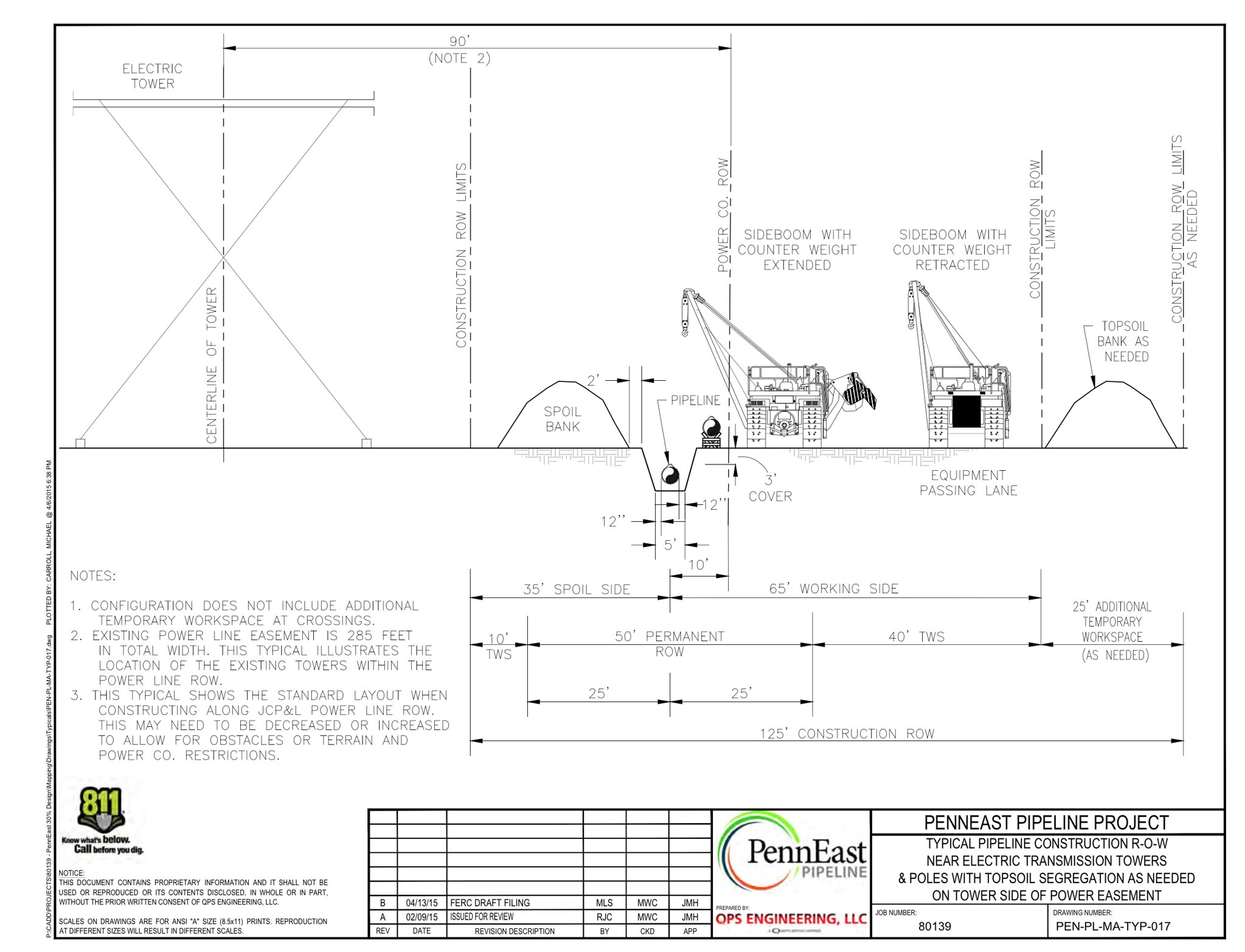
Appendix E contains plans for all sorts of different rights of way, and shows how construction will occur in all of these different circumstances. We’ll look at them all in detail in future posts, but right now I want to focus on one particular page. This page deals with the construction ROW as it will look in much of West Amwell and Hopewell NJ. This is the 285′ power line easement construction plan near electrical towers:

As you can see the pipeline has to be a certain distance from the vertical centerline of the electrical tower. At the same time they can obviously only utilize one side of the tower, so any cuts done on the far side of the tower are wasted as far as the pipeline is concerned.

This diagram shows how PennEast will setup the construction ROW where the power line easement is 285′ wide. This isn’t widely known at the moment, but this applies to areas in West Amwell and Hopewell, including around Baldpate Mountain. The cut is only 75′ to 125′ wide but the actual easement is 285′. PennEast plans on using most of that.

If you do a bit of math against the blueprint you can see that the construction right of way will extend 195′ from the centerline of the tower, or possibly 220′ if they need a separate topsoil bank.

For the towers around West Amwell and Hopewell, the towers are centered around the existing cuts in the forest, and the cuts themselves are around 100′ wide. This puts the centerline of the towers at the 50′ mark in the cut. Since all measurements are from the centerline, this means the total cut will be expanded from 100′ to 245′-270′ (depending on if they need that topsoil pile or not).

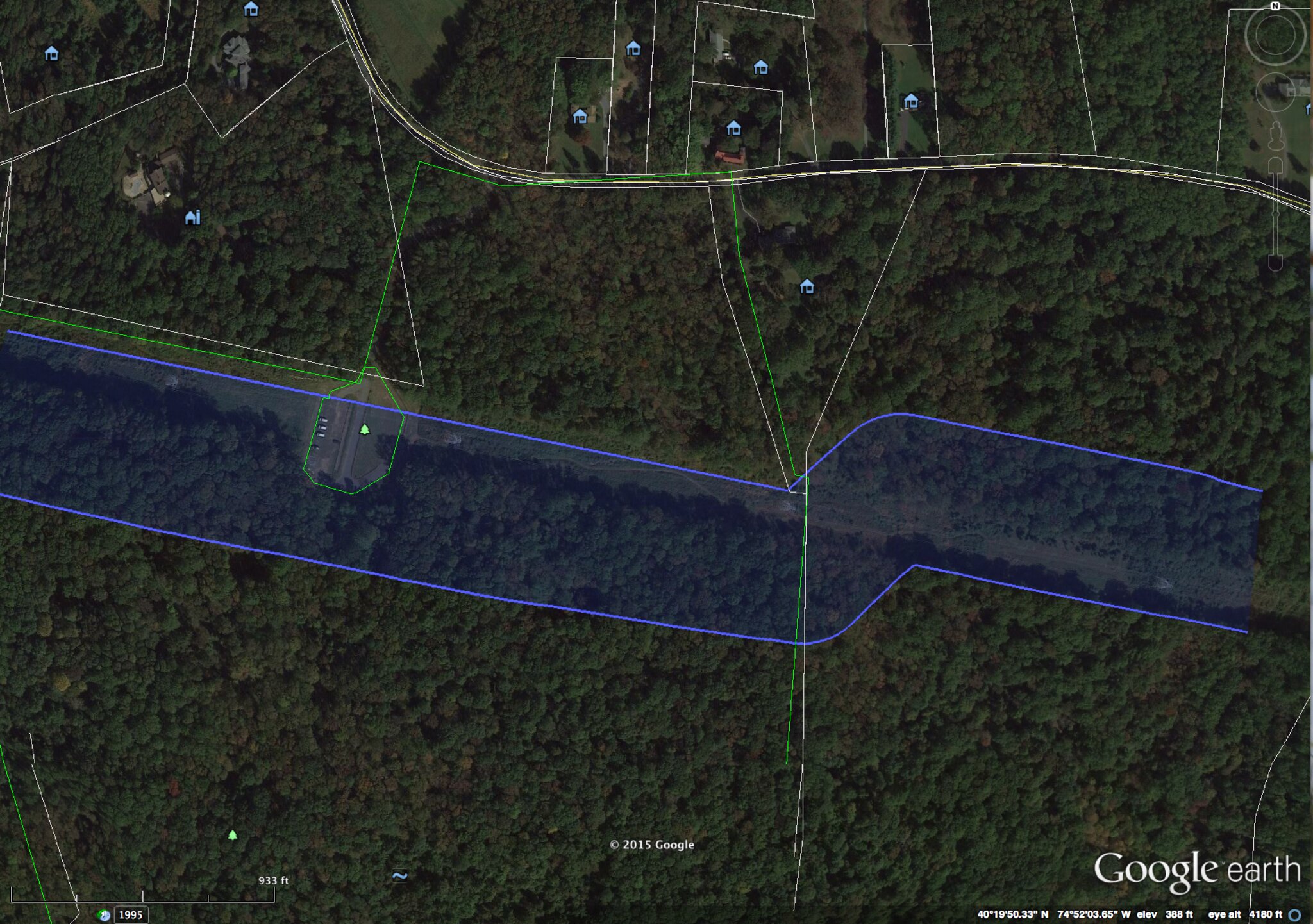
So in reality “co-location” isn’t what you may think. What it really is is widening the existing cut by 2 1/2 to 3 times its existing size! Take a look at the route along Baldpate with the existing cut:

The blue zone is the pipeline 400′ wide survey corridor. As you can see, most of the corridor is outside the existing cut. This is because of the construction layout as explained above. Co-location near my house in West Amwell and along Baldpate means clear cutting out an area close to 3x as wide as is cut now, and will leave us with a cut permanently 2x as wide.

As a bonus they will be obliterating the Baldpate parking area off of Pleasant Valley Road (green roughly circular area left of center in the picture above).

There is a similar story in other areas where the easement width is smaller at 120′. PennEast will likewise be significantly broadening the cut. At the same time they will have to not only deal with the JCP&L easement but also buy an additional easement for the extra space.

Clarification on Appalachian Trail Route Change in March 2015

A few days ago I posted my article detailing the route changes between January and March of 2015:

https://thecostofthepipeline.com/2015/04/25/march-30-2015-route-changes/

After the article was published Bill Steinmetz contacted me. Bill is a member of the Trails Committe of the Delaware Valley Chapter of the Appalachian Mountain Club. He emailed to let me know that my description of the Appalachian Trail pipeline re-routing was incorrect. In that section I said:

PennEast moved the trail in this section at the request of the trail maintainers“.

Bill let me know that the various AT organizations (local and nationally) did not ask PennEast to move the pipeline where they did. In fact, they objected to the route being a virgin cut across the trail, and asked that PennEast co-locate the pipeline along an existing corridor crossing. There are in fact three scoping comments on the docket from various A.T. people saying exactly that.

The Appalachian Trail Conservancy (ATC) posted this:

http://elibrary.ferc.gov/idmws/file_list.asp?document_id=14306905

…which said in part:

Any new impacts associated with the proposed development shall coincide with existing major impacts to the Trail experience

and went on to point out the issues with the route:

Based on the updated project maps provided by PennEast to the FERC on January 16, 2015, the pipeline would cross the A.T. on lands administered by the National Park Service Appalachian Trail Park Office and the Pennsylvania Game Commission in an area of undeveloped mature forest. […] pipeline construction would require clearing of vegetation for a 100-foot-wide construction right-of-way (ROW) and maintenance of a 50 ft. unforested permanent ROW after construction. [Based on the ATC’s policy above] we believe this site is an inappropriate location for the pipeline“.

They then go on to list several co-location alternatives that would be more acceptable.

The Appalachian Mountain Club (AMC) also posted to the FERC:

http://elibrary.ferc.gov/idmws/common/OpenNat.asp?fileID=13787942

They likewise objected to the new pipeline route through mature forest and state:

The applicant has failed to propose meaningful measures that would avoid or minimize these damages to the AT. AMC believes that co-alignment with existing transportation corridors, such Interstate 476 and/or Route 33, could greatly reduce the overall impact to AT and other public lands used for recreation. To minimize impacts, if co-alignment with existing transportation corridors is not feasible, AMC suggests that FERC should include an alternative siting location that co-aligns the project with the existing power line west of the Delps Trail, rather than creating an entirely unnecessary new right of way“.

This seems pretty clear to me – what PennEast proposed was an awful site, and they’d like to see it moved to somewhere where damage has already been done.

Finally a trail committee member, Dan Scwartz, made a submission as well:

http://elibrary.ferc.gov/idmws/common/OpenNat.asp?fileID=13788182

Dan says:

I volunteer maintaining the Appalachian National Scenic Trail (AT) and personally spend over 100 hours a year working to support the trail. I am concerned about new fragmentation of the forest along the trail. New
cuts through the forest create openings for invasives and also cause fragmentation of contiguous forest cover which impacts some species of wildlife. I would like to see this new pipeline co-aligned along existing infrastructure particularly in areas where it crosses forested lands such as the AT. For instance, in this case, the pipeline could be co-aligned with a powerline crossing of the AT that is a short distance away from the proposed AT crossing (between Delps and Little Gap.)“.

In all it’s abundantly clear that various organizations behind the A.T. are against new energy projects crossing the trail at new locations.  The cumulative damage to the trail area is unfathomable, and pipeline companies and other energy projects should strive to co-locate to save the peaceful nature of the trail and avoid further fragmentation of the forest and all of the problems that creates.

Instead PennEast chose to simply move the trail a half mile to the west on a different fresh cut across the trail area.  It’s not clear why this was done, but it’s possible they did it to avoid state and federal lands.  I’m still looking at this aspect, if I get any more details I’ll post them here.

In closing I’d like to apologize Bill, the A.T. conservation organizations, and all the trail maintainers out there for my gaffe, and thank them for sending in a correction.

Shadfest again today in Lambertville

We have Shadfest again today in Lambertville, I’ll be manning the DTCAP table from 12pm to 2pm, so come on down and keep me company 🙂 They have lots of great material and information including giant blow up maps of the pipeline route, the stoppenneast.org April News letter chock-full of information, white papers which tear apart PennEast’s faulty purpose and need justification, postcards to send to our legislators to get them to pass anti-pipeline legislation and a whole lot more.

If you have any friends or neighbors who have questions about the pipeline, it’s route, how to fight back, what their rights are, or just general questions about the process, send ’em on down and we’ll get them the information they need (or put them in touch with those who can).

The festival runs roughly 12:00 to 5:30, our table will be located in front of the store Zinc on Bridge Street near the corner of Main. If you don’t see us there there’s a slight chance we might move to Lambertville city hall, so check there if you don’t see us. That’s on North Union Street (th e main festival street) right at the end of the booths on York Street.